
School starts in a few weeks, and with that, students will be regaling their teachers about what they did over the summer.
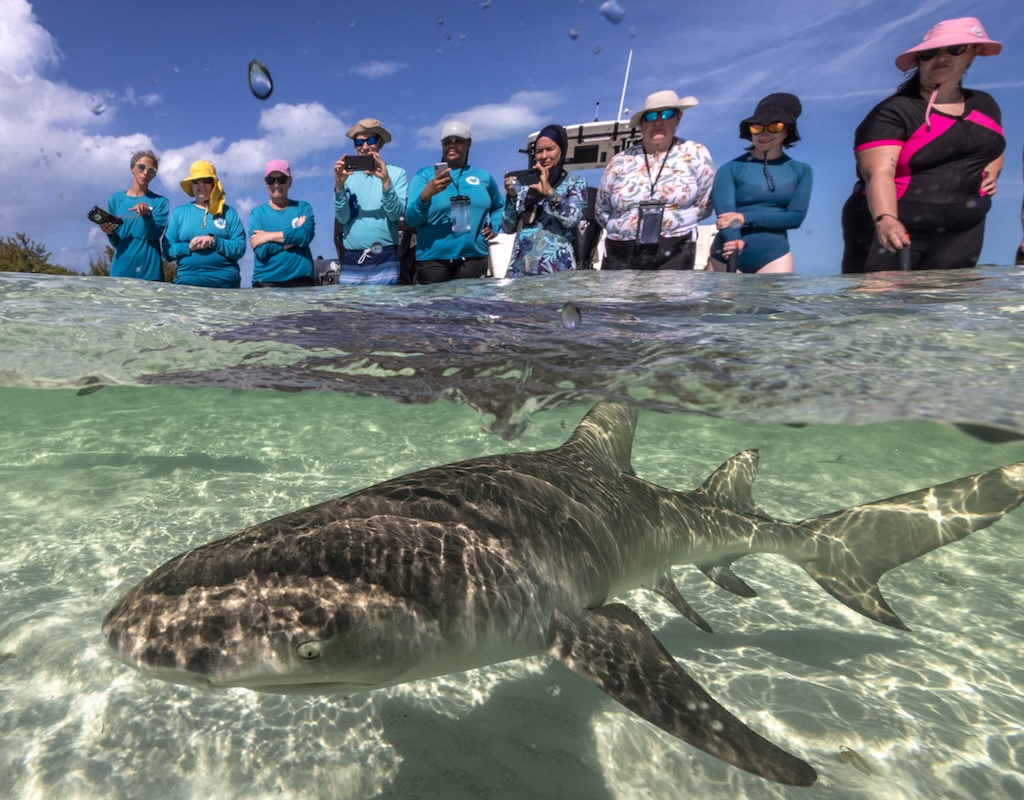
Students might have a hard time topping Bowler High School science teacher Kate Hansen, who spent much of her summer in the Bahamas, specifically about Bimini, learning about sharks.
The whole experience started when Hansen received notification from a Facebook group dedicated to helping teachers get scholarships for extended learning opportunities at museums, NASA and other places. When the notice about learning about the shark lab came up, Hansen’s interest was captured.
“I knew nothing about sharks, so I was, like, what is this all about?” Hansen said. “I started reading up on it, and it was about this lab that was in Bimini. I didn’t know where Bimini was, so I had to look that up.”
The specific lab, the Bimini Biological Field Station, has been operational for more than 30 years, according to Hansen, researching lemon sharks, a vulnerable species that can grow up to 11 feet in length and is known for its yellowish skin. They’re more commonly found in the Atlantic Ocean inhabiting areas from the coast of New Jersey all the way to southern Brazil.
The lab had started a summer institute for teachers about four years ago, and Hansen applied. She missed the first deadline, so she applied again. After a longer-than-expected wait, she learned she received one of the 28 available scholarships.
Hansen said she was determined to get into the institute, no matter what.
“I kind of thought, there’s no way I’m going to get this, but I’m going to keep applying until I finally do,” she said. “It was now a mission. I needed to go there and find out what this is all about.”
Prior to the institute, Hansen’s first-hand knowledge of ocean life was limited to jellyfish on a trip to the Mediterranean.
“I mean, we’re in Wisconsin. There’s not an ocean around us,” she said.
In one of her essays that was part of the application, Hansen noted her information about sharks was limited to watching Shark Week programs on television and a couple of episodes of “Nova.” Her humility appeared to do the trick, as she was sitting in the parking lot of Dollar General in Marion when she got the word that she got the scholarship.
“I reread that email so many times,” Hansen said. “I couldn’t believe that I was going to do this.”
Hansen spent about 50 hours total in the classroom going through the textbooks, but most of the time, about three to six hours daily, was spent out in the water, interacting with and researching the sharks.
“There are different types of sharks, but I didn’t know that some of them give live birth and some had like these egg things,” Hansen said. “It’s this evolutionary process. They learned that some of them started by giving live birth to egg to back to live birth. They can see the formations in their pseudo-uterus that they have. They’re not monogamous. They can have multiple mates.”
The lemon sharks Hansen researched give birth live during high tide behind the lab. The leaders of the institute quickly put Hansen and the other teachers to work on the first day, despite being jet-lagged, and they got to see some sharks in their infancy. She noted that lemon sharks at 1-3 months old are only one foot long.
“You learn that, if you turn them over, they kind of go into this stasis,” Hansen said. “In Bimini, there’s a law that says you can’t flip a shark over longer than five minutes because they have to reset their breathing, so we’re tagging and taking these genetic markers, and you have to do that in five minutes.”
The experience helped to dispel myths, such as that sharks don’t get cancer. Hansen said that they do, but the cancer is not able to spread throughout the body like it can in a human.
“Because there’s so much more cartilage, they don’t have an expanse of the cancer to fill their bodies like we do as humans,” she said.
One challenge Hansen had during the experience was snorkeling. She did some training at the pool at Clintonville High School but not a lot, because the weather had been colder in the spring and her trip was in June and July.
“They asked you if you could climb up into a boat using a ladder,” Hansen said. “(Clintonville) did have a ladder that I could practice with, and then when we got there (to Bimini), I was like, ‘Well, this is nothing like the ladder I practiced with.’ It was a lot easier getting out of the ocean onto the boat than what they had made it seem.”
Hansen plans to incorporate her summer with the sharks into her environmental biology classes so her students can learn. She has also been invited to give a lecture at the Navarino Nature Center, but details on when are still being worked out.
Hansen encourages all teachers to try out something like the summer institute and try to expand their horizons.
“I really want to get it out there that we should be applying as teachers to go to these things,” she said. “I’ve been talking with other teachers around me (and saying), you can apply to go this. You don’t have to be a science teacher to go. You just have to have a passion to want to learn about them.”
lpulaski@newmedia-wi.com


