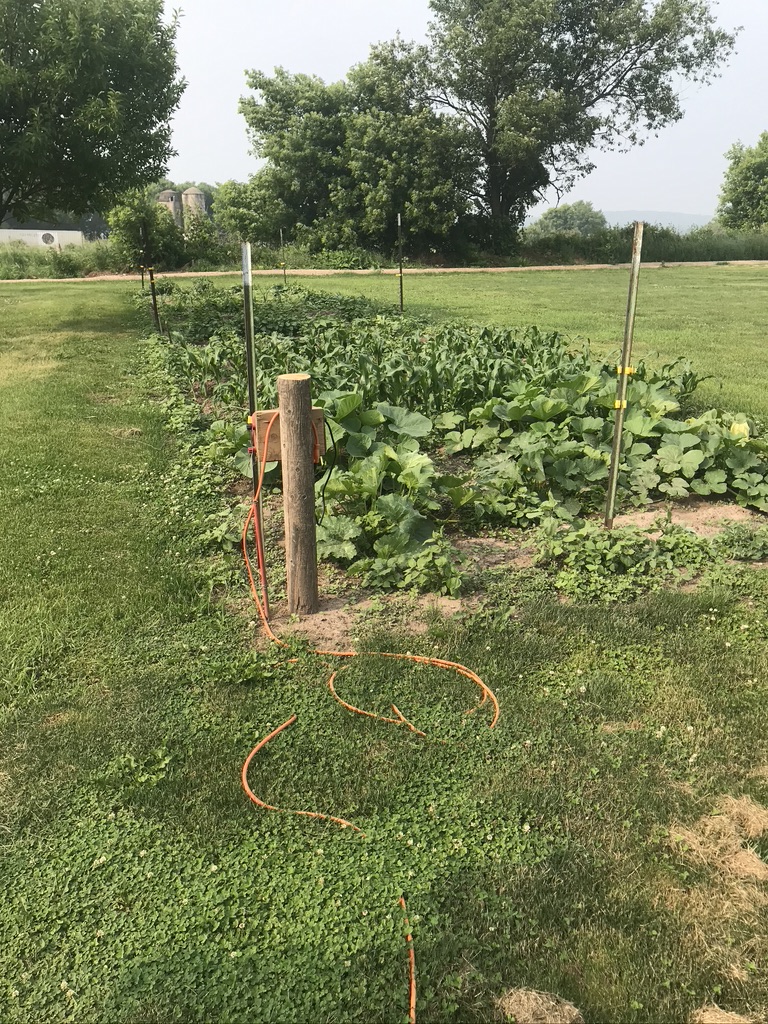
“Next year, we’re gonna put up an electric fence,” my husband declared, not without disgust.
We were gazing at a row of what once were flourishing broccoli florets, now nibbled right down to the stems. The deer had created havoc not only in the broccoli aisle of our personal open-air vegetable market, but as well they had less-than-daintily trod through three rows of knee-high sweet corn.
“It’s not like they don’t have acres of corn all around us. They gotta walk through our garden?” I groaned. It was too much work to see it trashed.
So this year after we planted corn, potatoes, carrots, broccoli, green beans, spinach, pumpkins, tomatoes, cucumbers and onions — and presently noticed everything coming up, — my husband chose a day to fashion an electric fence. Getting our supplies organized, we needed insulators, a wooden post, a post-hole digger, seven steel posts, barbed wire, a maul and a 3-foot long steel rod. Stashing all in the back of our four-wheeler, we drove over to the garden and started in.
My husband, through the years, has made his share of electric fences. Back in the day, we had heifers roaming our woods, and after planting season came fence-making season. He’d go around checking for damage and fixing or replacing downed posts and pulling sagging barb wire taut before letting the heifers free to roam on a 40-acre pasture. It was a lot of work. He and a couple of friends had put up a sturdy fence when we had been raising Black Angus. They hadn’t escaped once in all the while we had them, due to the craftsmanship of that fence.
Following his lead, this garden fence was a learning project for me. First, he dug a hole for the wooden post that would hold the electric fencer. Then we went around and as I held the steel posts, he pounded them in with a maul. After getting them placed around the garden, one on each corner and two across from each other in the middle, he clamped an insulator on each steel post.
Next, we strung one strand of barbed wire to each steel post, fastened on the insulator, ending up at the wooden post. He then wound the barbed wire to connect to the fencer. He also attached a single smooth wire to the fencer, winding the other end of the wire around the slim steel rod which he had driven into the dirt next to the wooden post.
“Why’re you doing that?” Inquiring minds want to know.
“To ground it.”
I didn’t want to appear dimwitted but, curious as to know just how grounding works, I asked Siri. Siri knows everything.
It took me to a website that explained: “To keep your fence working and in good condition, proper grounding is required. Your electric fence works by completing an electrical circuit whenever an animal touches the fence. The electric current originates at the energizer, travels down the fence, and goes through the animal to the ground. The soil then transmits the current to grounding rods which are connected back to your energizer, completing the circuit, and delivering a corrective shock to the animal. (Sorry, deer.) Grounding is essential in keeping the fence functioning properly.”
“A corrective shock” is a good way to put it. When we were all done and I had hauled an electric cord over, I ran it to the shed and plugged it in to the power source. Coming back to the garden, I asked my boss, “Ready?”
“Ready.”
Presently we heard a steady-as-a-clock, pulsating tick, tick, tick, which was pleasant to the ear but not so much to the touch. “Is it working?” I asked incredulously because to me, it was a marvel it had all been done so efficiently.
Pushing his farmer cap to the back of his head, says he with a mischievous grin, “Why don’t you try it?”
Smart aleck.
As the growing season is in full swing, I look at not only our garden and others, I note the sights around our farm and county and see the corn marching down fields in formation — along with soybean and oats that are flourishing, and second crop alfalfa is getting harvested. It never ceases to amaze me that seeds, seemingly so insignificant, can produce food in such abundance. What a providing Father we serve.
As of this writing, we are desperately in need of rain, so I’ll end my column this week with a prayer for moisture.
Father God, we come together kneeling before your throne in one accord to ask you to split open the sky and let a slow, soaking rain saturate your beautiful earth. Father, we ask this blessing of rain to come on behalf of growers all over our precious land. Our hard work of planting can only produce food for people and animals with sun and rain in due season. We thank you! In Jesus’ precious name we pray. Amen.
(“Ask the Lord for rain in the springtime; it is the Lord who sends thunderstorms. He gives showers of rain to all people and plants of the field to everyone.” Zachariah 10:1)
Kay Reminger was born and raised on a dairy farm, and she married her high school sweetheart, who happened to farm for a living in Leopolis. Writing for quite a few years, she remains focused on the blessings of living the ups and downs of rural life from a farm wife’s perspective.
FARM LIFE FROM A FARM WIFE: A shocking time of the growing season