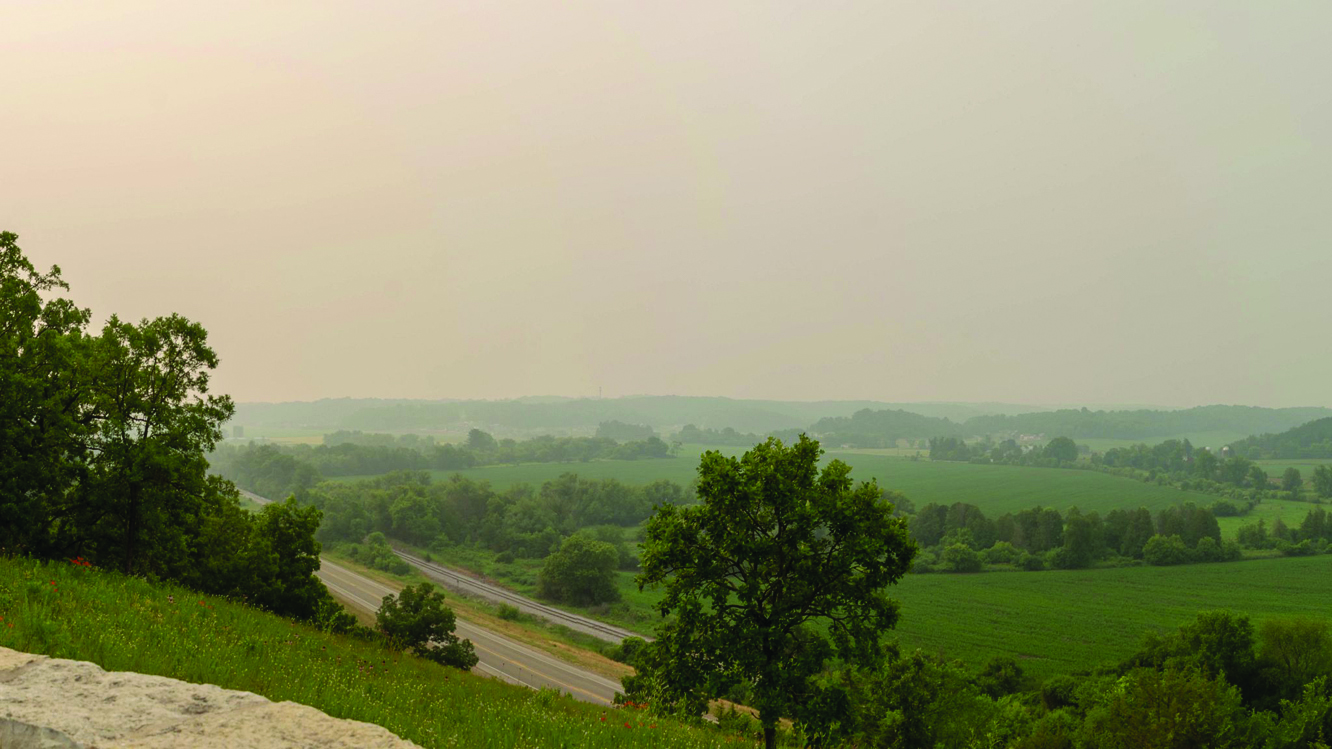
Massive fires burning stretches of Canadian forests continue to blanket the northeastern United States and the Great Lakes region, turning the air yellowish gray, and prompting warnings for people to stay inside.
Locally, while the hazy conditions can be seen with ease, health officials are reporting little to no concerns expressed by the public.
“At this point, we do not have any questions raised by the public to our department,” said Nick Mau, assistant health director/officer with the Shawano-Menominee Counties Health Department. “We are urging people with compromised breathing conditions to follow CDC guidelines.”
Those at a higher risk of suffering from wildfire smoke include children, pregnant women and individuals with chronic health conditions such as asthma, COPD and heart disease. Individuals who work outdoors could also be affected.
The health department urges residents to check https://www.airnow.gov/ every day. All children are included in the definition of sensitive groups, as are people with many chronic health conditions. Follow the AirNow recommendations to decide whether to work or play outside.
“Wildfire smoke can have on the lungs, especially for older adults, pregnant women, children, and people with preexisting respiratory and heart conditions. If there is enough smoke in the air, it can affect someone who is healthy if they are exposed to it long enough,” according to a spokesman for HSHS St. Clare Memorial Hospital Prevea Gillett Health Center. “As for the HSHS St. Clare Memorial Hospital Prevea Gillett Health Center, our providers shared that they have not noticed a significant increase in the number of patients experiencing respiratory issues at this point.”
Drifting smoke from wildfires across Canada is creating curtains of haze and raising air quality concerns throughout the Great Lakes region, and in parts of the central and eastern United States.
For more information on protecting yourself during low air quality days, visit cdc.gov/disasters/wildfires/smoke.html.
Recent rainfall in Canada was not enough to extinguish the wildfires ravaging northern Quebec, but the wet weather could give firefighters a chance to get ahead of the flames, officials said, as Canada surpassed the record for area burned by wildfires this week.
A multi-day air quality advisory due to the smoke from the wildfires was issued by the Wisconsin Department of Natural Resources from June 27-29.
“The air quality index is ranging from the unhealthy for the sensitive groups level to the very unhealthy level,” said Craig Czarnecki, Wisconsin DNR public information specialist, at the start of the advisory. “The entire state of Wisconsin is included in this advisory.”
The most dangerous part of the state was along its eastern border, with the level of pollution in Milwaukee so bad it was among the worst across the globe, he said.
The DNR issued tips on ways to avoid wildfire smoke is to stay indoors — close windows and doors, run the air conditioning and use an indoor air purifier. For those who must spend time outdoors during air quality advisories, they are urged to check air quality conditions before leaving the house and throughout the day, avoid or limit exercising outdoors and consider wearing an N-95 mask, especially if outdoors for an extended period.
“A lot of the areas where these fires are burning, they either can’t extinguish the fires because they’re in such remote areas or they just don’t have the staff,” said Ron Schneider, Wisconsin DNR cooperative fire specialist. “They’ve brought in firefighters from France, from Italy, Australia, Mexico, so they have a lot of help from partners to extinguish these fires.”
He said many of the particles are so small, they can’t be filtered by wearing a mask.
Meanwhile, NASA is reporting that smoke from wildfires in northern Quebec has reached Europe. The American space agency said satellite imagery from Monday showed smoke extending across the North Atlantic Ocean to the Iberian Peninsula, France and other parts of western Europe.
Air quality in Europe has not deteriorated to the extent seen in Canada and the U.S., however, because of the height of the smoke in the atmosphere, according to NASA.
In Quebec, where nearly a quarter of the fires are burning in Canada, the province’s forest fire prevention agency — SOPFEU — is evaluating the effects of recent rainfall, Katia Petit, Quebec associate deputy minister for civil protection, told reporters.
Despite the rain, the task of controlling the province’s fires remains “colossal,” said Julie Coupal, SOPFEU assistant director. The agency counted more than 100 wildfires across the province, including 77 in the southern half, where more than two dozen fires were considered out of control.
The Canadian Interagency Forest Fire Centre reported that 29,393 square miles of forest and other land has burned across Canada since Jan. 1. That exceeds the previous record set in 1989 of 29,187 square miles, according to the National Forestry Database.
Currently, there are 490 fires burning nationally, with 255 of them considered to be out of control.
kpasson@newmedia-wi.com
Canadian wildfires lead to hazy conditions