
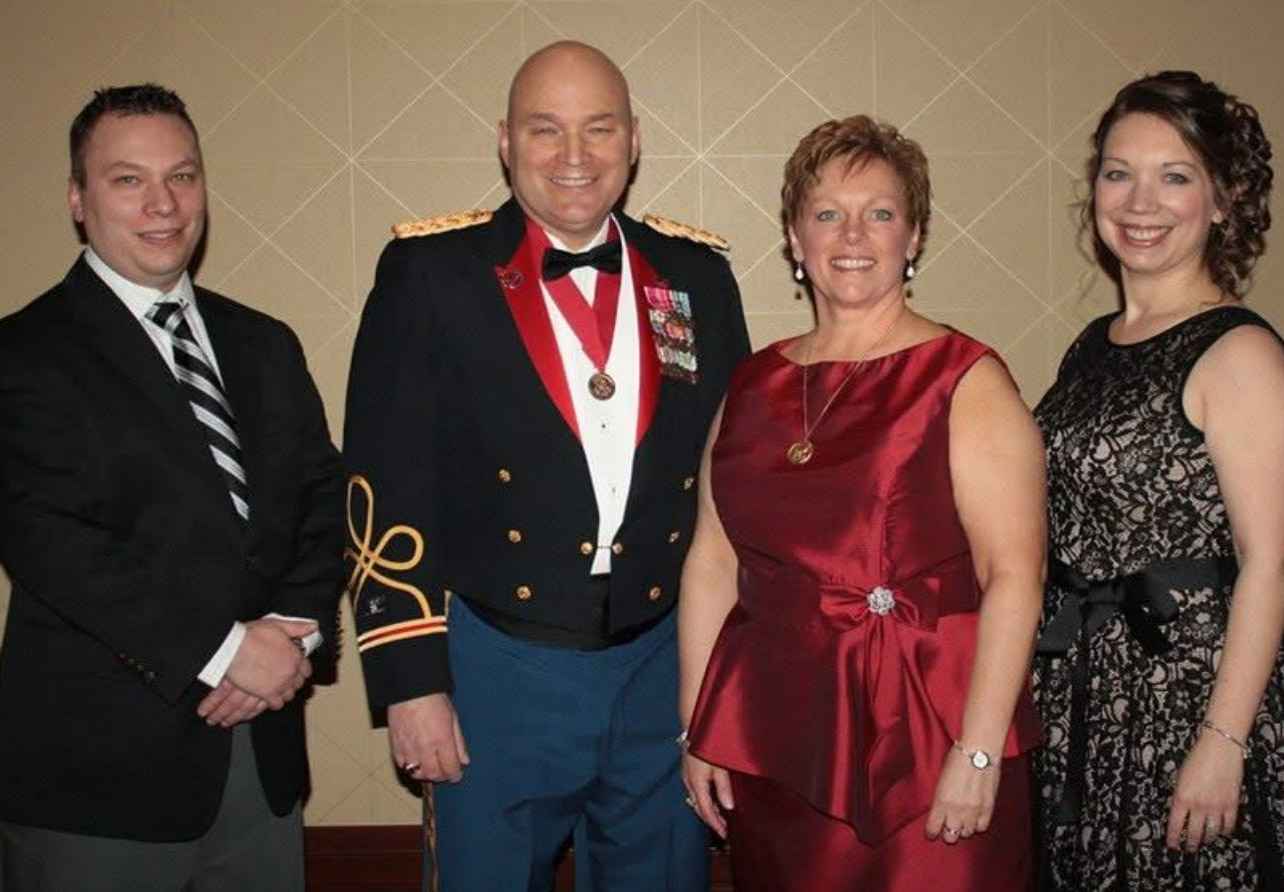
Col. Richard Kucksdorf retired from military service on December 2013, after serving 34 years with the United States Army.
“When I was a kid in sixth grade, I started reading military history,” said Kucksdorf. “By the time I got to high school, they had big libraries and more of a selection. I read every book on World War I and World War II, drawing navy ships, designing what I thought would be a perfect navy ship. I had every notion I’d join the navy.”
Graduating high school in 1972, the draft had ended January 1973. A few of Kucksdorf’s friends at that time decided to go to college to avoid the draft, as they wanted to go “discover themselves.”
“My dad’s concept was if you wanted to discover yourself, stay home and shovel cow manure,” said Kucksdorf. “So, I decided I was going to go off on my own. I knew I could get the GI bill to pay for my college education.
“Me and a few friends decided to join the military. We did what was called a ‘delayed entry’ in April 1972. We went on active duty July 1, 1972,” said Kucksdorf.
Kucksdorf was stationed in Korea for a year. During that deployment, Kucksdorf taught English at a Korean orphanage. His battalion financially helped to support this orphanage, which was populated with children of American soldiers. They were shunned as a result of their genetics.
In May 1975, three years after enlisting, Kucksdorf’s father experienced a back injury, and Kucksdorf was discharged with a hardship discharge to work on the farm. After his discharge and working on the farm for about six months, Kucksdorf was employed at different jobs while still living at home and working on the farm.
Stopping in one day at the National Guard Armory in Clintonville, he’d developed friendships with guys who prompted him to sign up with the Wisconsin National Guard.
“After signing up for the National Guard, everything fell into place for me. I just knew this was what I was supposed to be doing,” said Kucksdorf.
Kucksdorf received his commission by attending Officers Candidate School (OCS). He was commissioned as a second lieutenant Dec. 6, 1985. Kucksdorf attended several active-duty professional development schools and served in various positions in the Wisconsin National Guard, rising to the rank of lieutenant colonel. Kucksdorf transferred from the National Guard on Oct. 1, 2002, to the United States Army Reserves stationed at Fort Sheridan, Illinois.
Kucksdorf had various jobs during his 34-year career, starting out an enlisted soldier rising to the rank of sergeant before attending OCS and receiving a commission. Kucksdorf was promoted to colonel on Feb. 6, 2006.
“I met a lot of good people,” Kucksdorf said. “Went to 32 different states, spent time in Korea and Iraq, including two combat commands in Iraq. In Iraq, I was not part of a unit but was an individual selectee and was combined with other individual selectees. We were put into nine-man teams. Almost everyone had combat experience or an equivalent. Every member of the team was a staff sergeant or above or a captain or above. We’d help them plan missions and watch them conduct the mission. Our goal was to be sure they could plan a mission on how to capture and defeat ‘the bad guys.’”
Kucksdorf’s first command was taking several nine-man teams to embed with the Iraqis. His teams assisted with setting up the first Iraqi constitution and assisting to safeguard the vote Oct. 15, 2005. Next was the first-ever election for president, which happened Dec. 15, 2005. Kucksdorf’s second Iraq command was to advise the Iraqi CORP Commander who commanded 20,000 Iraqis troops.
Kucksdorf and his embedded nine-man teams helped establish a democracy in Iraq.
“We wanted them to be able to stand on their own. We wanted to get out of there,” said Kucksdorf. “There was one nine-man team setting up Ministry of Oil or Energy, another one setting up Ministry of Agriculture and the first-ever version of the Iraqi Stock Exchange. Iraq had none of that.”
Since retiring, Kucksdorf has written a book that at this time requires a process for clearance of classified and sensitive material by the Department of Defense prior to publishing. The book doesn’t focus on combat but instead emphasizes establishing an Iraqi government and building their democracy.
One job Kucksdorf was assigned was to write what was called the Military Table of Organization and Equipment (MTOE), which detailed what equipment a corps requires, such as how many vehicles, rifles, pistols, what mechanics tool kits, dental kits, barber kits, cooking kits, etc. are necessary – everything an army of 20,000 men would need. The MTOE was established in order for the United States to know what type and how many items they would need when they sent equipment to supply this Iraqi corps.
In 2006, Kucksdorf was asked by an active duty general to be a G-3, or chief of operations for an active-duty division to assist with the mobilization of American units to deploy overseas. The unit was 1st Army Division East, located at Fort Mead, Maryland.
Kucksdorf was in charge of all operations and training of all mobilizations. If a unit was mobilized to a fort east of the Mississippi River, that unit fell under the jurisdiction of Kucksdorf. He made sure the soldiers were trained, equipped and healthy, which included dental work.
“Many times, I’d have to fly in a team of oral surgeons and hygienists to get them healthy before deployment,” said Kucksdorf.
Graduating in 2010 from the War College at the Carlisle Barracks in Pennsylvania, Kucksdorf earned double masters in international relations and strategic studies. This was an extremely competitive school with over 14,000 applicants. Just under 700 were accepted and approximately 300 U.S. and international students graduated.
Currently, Kucksdorf heads up one of two boards for selecting attendees to military academies from the 8th Congressional District for U.S. Rep. Tony Wied. Kucksdorf interviews potential applicants that desire to enter a military academy such as West Point, Air Force Academy, Naval Academy, Merchant Marine, etc. Kucksdorf peruses everything from academics, to extracurricular activities to attitudes.
During his military career, Kucksdorf was extremely grateful for his supportive wife, Connie.
“She did everything. We’re a good team. There’s no way that I could have been as successful in the military if Connie hadn’t been there to support me. Done deal,” said Kucksdorf. “We also have wonderful neighbors who helped her out.”
Like all National Guard and Army Reserve soldiers, Kucksdorf had a dual career. Besids the military, Kucksdorf was with the United States Postal Service, retiring as postmaster of the Kaukauna Post Office.
Kucksdorf encourages any young man or woman graduating high school or out for a few years finding themselves without a purpose, to join the military. They’d be trained in any profession they’d be interested in, be it dental hygienist, electrician, welder, logger, diesel mechanic, electronics on an airplane, police force, etc. It would pay for college or a establish a home loan.
“In the military, everybody starts on the same line, no pecking order. You either step up to the plate or you don’t. The military won’t give up on you if you don’t give up on you,” said Kucksdorf. “People tell me, ‘Thanks for your service,’ but I honestly say, I can never give back as much as I’ve been given. This is a great country, has given me lots of opportunities, and I got to work with some pretty phenomenal people. We’re a family.”

Col. Richard Kucksdorf poses in his dress greens at his home in rural Bonduel in the summer of 2008. (Contributed)

“Bullets to Ballots,” written by Richard Kucksdorf, chronicles establishing an Iraqi government and building their democracy. As yet unpublished, the book requires a process for clearance of classified and sensitive material by the Department of Defense.


