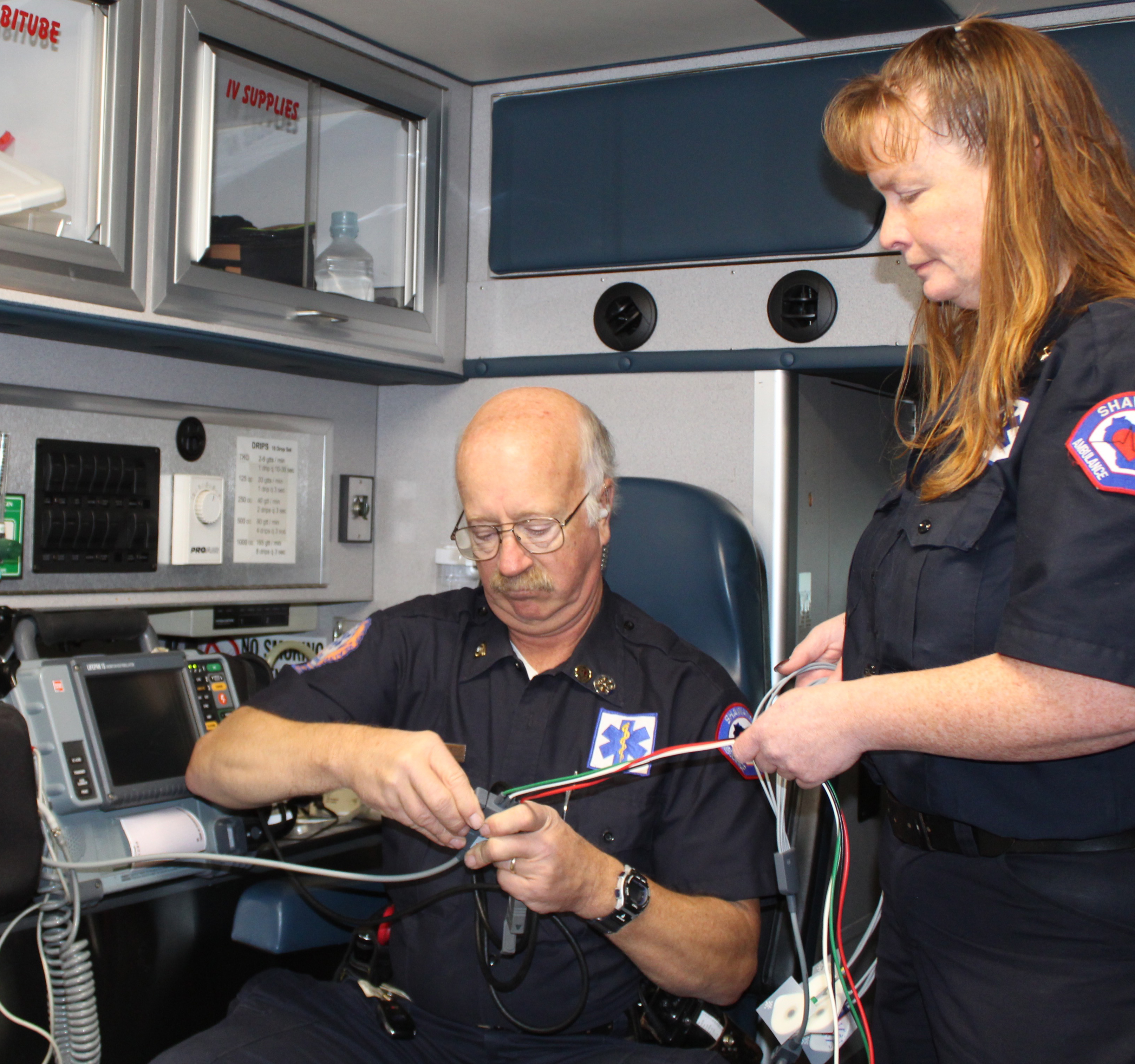
SHAWANO — Although Pat Trinko, director of operations, hesitated to engage in he called “tactful bragging,” the Shawano Ambulance Service has been recognized as a top provider in the American Heart Association’s 12-state Midwest region because of its response to a specific kind heart attack.
The ambulance service is one of four among Wisconsin’s 425 providers to receive the designation of Mission: Lifeline “Gold Plus” — the highest recognition of its kind. The others are Kenosha, Reedsburg and West Bend.
Part of the credit for the award goes to the ambulance service’s coordination and communication with area hospitals, Trinko said, in treating patients with STEMI, or S-T Elevation Myocardial Infarct. STEMI is an attack where cardiac arteries become blocked “that can be readily identified in the field and is very time-sensitive,” he said.
Restoring oxygen and nutrients quickly greatly increases a patient’s chances of survival and recovery, according to the service website. A seamless exchange of information between paramedics and hospitals is also critical, said Trinko.
“We need to get a person somewhere and get that blockage cleared and get the blood flowing again,” Trinko said.
For Shawano County, that “somewhere” is a catheterization lab, essentially an operating room dedicated to opening blocked arteries, found in Wausau, Appleton and Green Bay hospitals.
“To get to this level, we need to have standing agreements with area hospitals,” Trinko said.
The patient benefits by skipping a stop in an emergency room, also saving time.
Janelle Lange, one of the shift captains for the service, agreed.
“We want to make sure the cath lab team is available and ready,” Lange said, noting they are sometimes re-routed to a different hospital.
Lange echoed the time sensitivity for STEMI patients. She said their average on-scene arrival is 15 minutes or less and arrival at a cath lab is often 50 minutes or less. The service website said that the service can consistently deliver a patient to Green Bay and Appleton cath lab 10 to 15 minutes faster than air transport with the same level of care.
Lange noted the service’s paramedics are trained in responding to heart attacks, including STEMI, and can administer a variety of drugs while en route.
“The more pain a patient is in, the more stress there is on the heart,” said Jay Sailer, a Shawano service paramedic.
The primary tool in the identification and monitoring of STEMI is the Lifepak 15. According to the Shawano Ambulance Service website, they are the only EMS provider in the region that uses both 12-lead and 15-lead EKGs as their standard of care for identifying which patients are candidates for immediate catheterization procedures.
The Lifepak 15 and paramedic training combine to make STEMI identification and treatment most efficient, Trinko said.
The AHA award program, now in its fifth year, seeks to promote a coordinated system of care among ambulance services and hospitals.
Shawano Ambulance Service receives heart association award