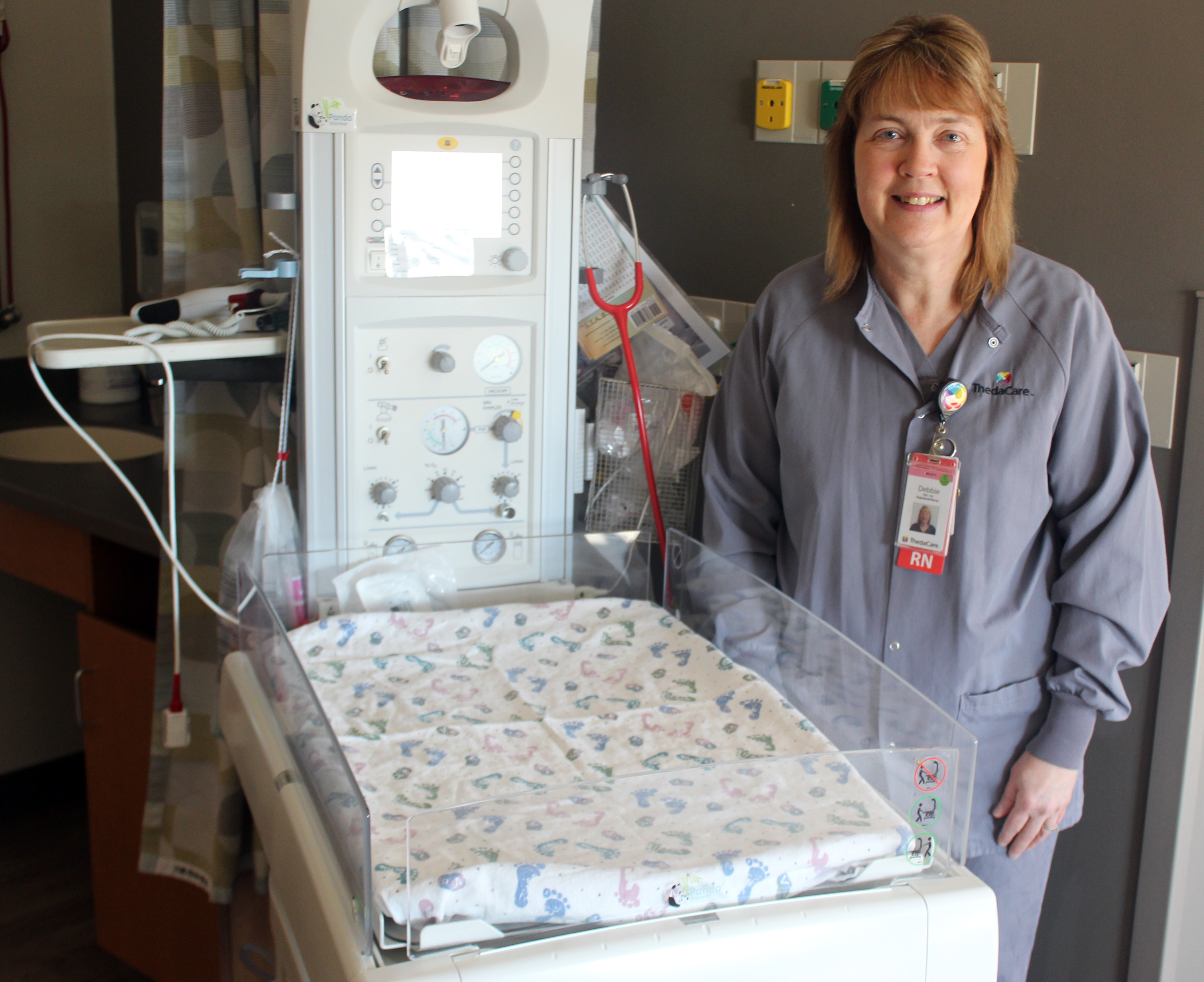
SHAWANO — Countless children have been born in Shawano’s hospital in the last four decades, and Debbie Fabry has had a hand in delivering many of them.
Fabry, a registered nurse at Family Birth Care at ThedaCare Medical Center-Shawano, has been a common face during deliveries, helping parents to bring their children into the world. Days, nights, weekends and holidays, Fabry has worked at the hospital for the last 40 years to bring joy to families.
Fabry’s interest in nursing grew out of a visit she made to the hospital with an aunt, when Fabry was 10 years old. At the time, her younger cousins were not old enough to be allowed into the hospital, but Fabry was at the right age.
“I was very nervous walking through the halls and trying to act so grown-up,” Fabry said. “I kept looking in the rooms as we went by, thinking ‘I wonder why all of these people were here. I wonder what they need or what’s happening with them.’”
Fabry recalled telling her mother as a child that she wanted to be either a nurse or an airline stewardess. Following that hospital visit, the airline industry lost a potential employee.
“I just thought that I wanted to help these people who are sick or needy,” she said.
In Fabry’s senior year of high school, she wanted to learn how to become a licensed practicing nurse, and her opportunity came before she even graduated from high school. She had planned to graduate a semester early to start her nursing education, but officials from Northeast Wisconsin Technical College called and asked her if she’d like to start right away, even before getting her diploma.
“I had to get special permission from my high school to graduate two to three weeks earlier than my semester ended in January,” Fabry said. “I moved to Green Bay, but I still had to go back and take my finals so I could get my diploma.”
Fabry became a licensed practicing nurse in 1980 at what was then Shawano Community Hospital, and then she pursued further education in 1982 to become a registered nurse. She obtained her bachelor’s degree in 1984.
Fabry’s classes gave her experience in all hospital departments, but when she got to her last class in maternity, she knew that was where she wanted to be.
“I was very intrigued with maternity nursing,” Fabry said. “I just really liked taking care of the moms and the babies, just helping them through the process. I just knew that I liked that and hoped I could find a job doing that.”
Living in Suring, Fabry had the choice of working in Oconto Falls or Shawano, but Fabry was interested in working in Shawano because of the maternity ward. Hospital officials at the time told her she would need to start out as a general nurse — the same as other new nurses who came before her. But a week after starting, the officials came back and said there was a nursing position open in the maternity ward.
In larger hospitals, Fabry would have had to choose whether to work in labor and delivery or working with mothers after the birth. With Shawano’s hospital being as small as it is, Fabry is able to work with parents through every aspect, from the moment they arrive at the hospital to the moment they leave with their new child.
“This just feels like my area to be, helping the moms through the birth process, and I find it really rewarding to be part of this big, major event in their family — the birth of a child,” Fabry said. “We all celebrate in the end. It can be very intense when they’re going through labor, but then the other side is that it’s very rewarding helping them get to that point.”
While most of the births were happy ones, there were occasions where children were born stillborn or other complications developed. Fabry decided to add to her repertoire by learning to be a perinatal counselor.
“Helping them to honor their baby, even though it’s not the outcome they hoped for, it’s still special to them,” Fabry said. “Even if it’s a miscarriage or a stillborn, it’s important to help them work through that.”
In the last 40 years, the process of delivering babies has changed a little. Fabry remembered that there were no electric monitors to detect fetal heartbeats and no epidurals when she started, and more male doctors were involved with delivering babies. Now, most of the doctors for maternity are female.
Deliveries took place in a delivery room decades ago, and only the father of the child was allowed to be present for the delivery before mothers were sent to their rooms and babies were put in their own special area to be cared for. Now, according to Fabry, babies get to stay in the hospital room with their mothers from the beginning if they are in good health, and rooms are now big enough for families to share in the delivery.
Fabry has been asked if she’d like to do more management work in recent years, but she insists she’d rather be with the patients.
“I just want to be at the bedside, taking care of the patient,” Fabry said. “I think that’s what’s kept me going at times when it’s seemed hard, and I just spend time with the patients. At the end of the shift, you can tell you made a difference in their lives that day.”
lpulaski@newmedia-wi.com
Still delivering after 40 years