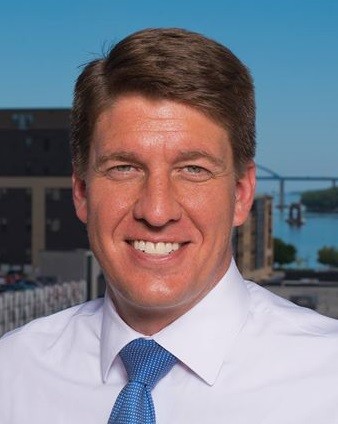
State Sen. Eric Wimberger met with the board of the Oconto County Economic Development Corp. on Aug. 3 to discuss the impact of the newly passed 2023-25 state budget on local municipalities.
Wimberger, R-De Pere, represents the 30th Senate District, which includes the City of Oconto and the towns of Little Suamico, Abrams, Oconto, Pensaukee, Stiles and Little River on the east side of the county. He is a member of the Joint Finance Committee that amended Gov. Tony Evers’ proposed budget before the Legislature considered it. Evers signed and partially vetoed the final version of the budget July 5.
In an interview with NEW Media after meeting with OCEDC, the senator said he and the OCEDC board talked about the shared revenue, workforce housing, land use and development and other local issues, and he asked for suggestions as he works on a bill to disburse $125 million in PFAS mitigation grants.
Sen. Mary Felzkowski, who represents most of the rest of Oconto County, was the point person for figuring out the details of a provision to increase the amount of state shared revenue going to the state’s cities, towns and villages.
“A lot of municipalities are going to be in a lot better shape funding their EMTs and other emergency services,” Wimberger said. “I think that’s a good step in the right direction.”
School districts with historically lower revenue limits will see a state aid increase to $11,000 per student, and public, charter and choice schools saw increased funding in general, he said.
“Schools are certainly in better shape than they were,” Wimberger said. “The trouble is always when people say things like ‘We need to fully fund our schools, but then don’t have an idea as to what the definition of ‘fully funded’ means.”
Wimberger said in his view the challenge is to make sure students can achieve their potential.
PFAS pollution
Inclusion of the PFAS funding in the budget is a feather in Wimberger’s cap, because he has spent more than a year arguing for relief on behalf of property owners and municipalities impacted by PFAS contamination in Marinette County. He was able to convince the Joint Finance Committee not only to meet the governor’s request for funding but to increase it to $125 million.
“That’s a very good start,” he said. “Because I was the squeaky wheel, now I’m in charge of applying the grease.”
He is responsible for drafting a bill that allocates the dollars to those who need it.
“When there’s environmental damage involved, we have to work through those and figure out the right path,” Wimberger said. “We have to find the balance of making sure the pollution is taken care of, making sure the people who caused the pollution don’t skirt over responsibility that would otherwise be there for them to face, and also to maintain property values of the people who have polluted land is important.”
Another issue Wimberger was pleased to advance in the budget was funding for the southern bridge near De Pere, which is expected to provide a new way for drivers to cross the Fox River between De Pere and Wrightstown.
Supreme Court changes
The state Supreme Court saw an ideological shift just before the Aug. 3 interview with the installation of newly elected Justice Janet Protasiewicz, giving justices with a liberal judicial bent the majority for the first time in several years. Wimberger said the shift isn’t necessarily consequential as long as the rule of law continues to prevail.
“I guess that’s to be determined,” he said. “You’ve had a couple of justices talk openly about topics that sort of pre-judge cases if they were to come, and that’s not good news for our system of government, but I guess it’s to be seen if it’s just rhetoric and they’ll abide by our rules or not.”
A group of Democrat-leaning organizations wasted no time in filing a lawsuit against what they called Wisconsin’s gerrymandered legislative districts. The state Supreme Court chose the district maps after a legal battle between Evers and the Legislature that traced its roots to the maps drawn after the 2010 Census.
“You know, there’s only one map that was declared to be gerrymandered, and that was Gov. Evers’ map,” Wimberger said. “It was determine to be gerrymandered by race, because his map had cracked the Black population in Milwaukee.”
There have been no new facts or law since that decision to justify a lawsuit, he said. The only change is the arrival of Protasiewicz to tip the perceived Ideological scales.
“If you can simply bring a new case because a new judge would have done something differently in your mind, then there are thousands of cases in front of the Supreme Court, or if you’re a local judge retiring and you don’t like how your adjudication of property was handled in your divorce proceedings, you’d be able to just reopen it, and you simply can’t do that in our system,” Wimberger said. “There’s something much more fundamental than the maps themselves at issue.”
wbluhm@newmedia-wi.com
Wimberger talks budget, PFAS, Supreme Court