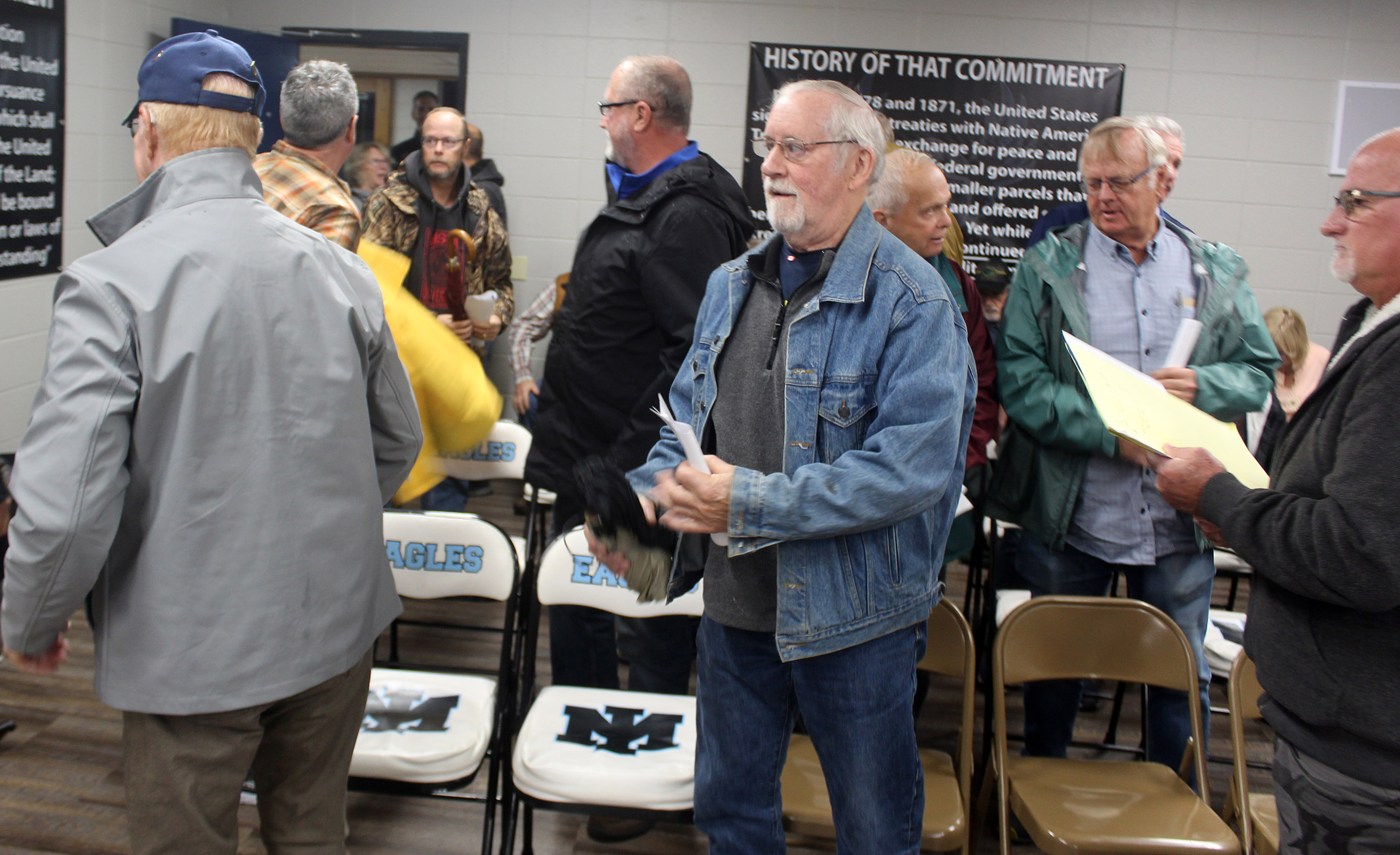
Over 40 taxpayers filled the room where the Menominee Indian School Board held a special midday meeting Oct. 24 to approve a tax levy, hoping to voice their opinions on the matter. However, the board made it clear that the decision no longer rested with the people.
The board unanimously approved a levy of almost $5.56 million, which puts the tax rate at $8.63 per $1,000 of equalized valuation, meaning that property worth $100,000 could expect to be taxed $863 by the school district. It was $231,314 more than it had requested at the district’s annual meeting on Sept. 27, which was voted down by the taxpayers present.
A number of property owners wanted answers as to why the board was going to approve a higher levy instead of the original one, which would have put the tax rate at $8.27. However, when the meeting started, Superintendent Wendell Waukau made a statement that the meeting was one for board discussion, not an additional meeting of the electorate, so public comment was not going to be taken.
“The board, under its powers, is taking action to approve the levy, which is part of the powers of the board,” Waukau said. “It is not a regular meeting, which includes public comment, and that is in our policy. The purpose today is to have a review of the levy, which relates to our budget. The board will discuss that among themselves, and then they will proceed with the action item.”
Kyla Davis, the district’s business manager, noted that Menominee Indian School District’s actual revenue limit is over $8 million, and if the district had opted to levy to the maximum, the district’s tax rate would $12.68, because the funding would be a 44% increase over last year.
Davis noted that final state aid numbers were not made available until Oct. 15, and it turned out the estimates were off, which is why the board was looking at the $5.56 million levy instead of the $5.33 million presented at the annual meeting.
“Unfortunately, we did not get good news with our aid estimates,” Davis said. “We received $1.2 million less than we expected on our estimated budget, which means the budget looks different than what we previously presented.”
MISD did not receive any sparsity aid from the state, according to Davis, because it did not meet the threshold of having a student count below 745. Also, some of the aid loss is due to private school voucher programs with the reservation bordering Shawano County, where there are several parochial schools available to families wanting a different type of education for their children.
“In our general fund, compared with what we presented before, we’re reducing by $566,000 compared to the 2022-23 general fund budget,” Davis said.
Underlevying is a way to reduce taxpayer burden, she noted, and the district has underlevied by $13 million in the last decade. However, it is an impact to school resources, as well.
“We’re decreasing the number of staff we can have for our students,” Davis said. “We reduce the resources for our classrooms, which can lead to outdated materials. It also leads to fewer extracurricular activities, because it reduces the amount of money we can use for after-school programs.”
That piece of news concerned board member Regina Washinawatok, who asked what was being cut from the general fund this year.
“Are we going to have to eliminate some programs, have larger class sizes?” Washinawatok said.
Davis pointed out that most of the cuts come from proposed capital improvement projects, including building updates and renovations.
“It doesn’t directly impact the classroom this year,” she said.
lpulaski@newmedia-wi.com
Public silenced in school board levy vote