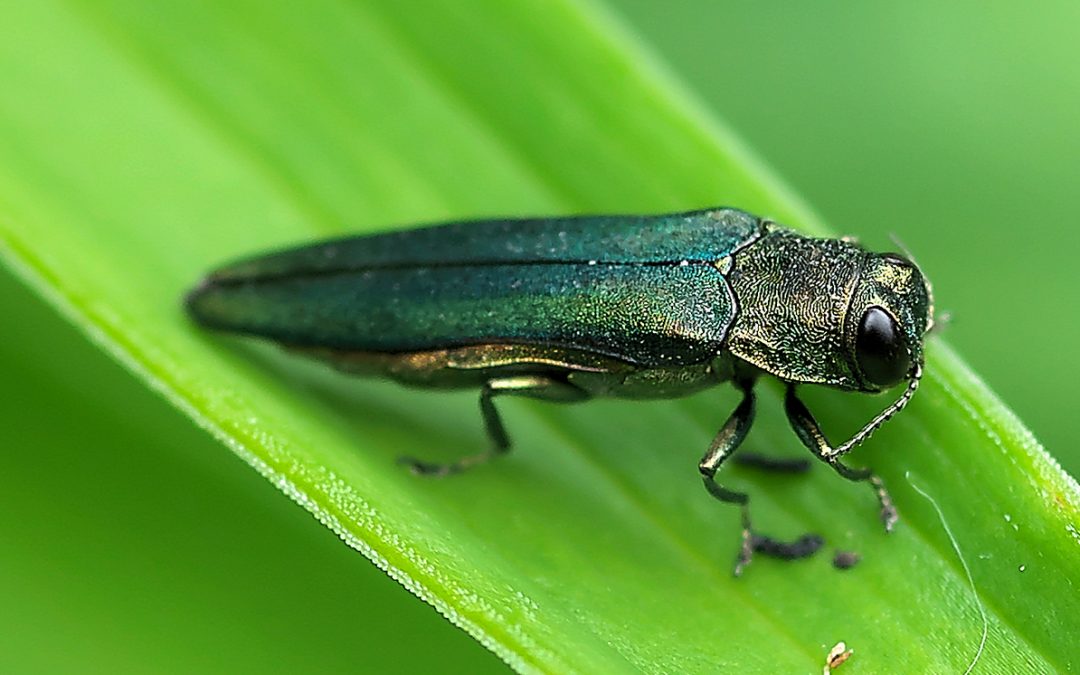
The emerald ash borer is devastating ash trees all across the Midwest, but the Wisconsin Department of Natural Resources is using parasitic wasps to fight back.
The Shawano Common Council gave the go-ahead Aug. 9 for the DNR to coordinate the wasps’ release in an area of the industrial park to combat the ash borer. The wasps are not expected to save the trees that are already infested but can potentially prolong their life.
Public works director Scott Kroening brought the matter before the city’s field committee and received its support. The wasp is about the size of a fruit fly, solitary in nature, and it spends most of its life in the ash trees, laying eggs in the larva of the ash borer.
“With the ash trees in the city and throughout the state, they’re trying to find some that are resistant to the emerald ash borer,” Kroening said.
Alex Feltmeyer, a forest health specialist for the DNR, told the council that the ash borers, native to Asia, that are infesting trees in Wisconsin originally were found in Detroit. They are being spread primarily by the moving of firewood. She said that Wisconsin was first infested by the invasive species in 2004 in Ozaukee County, but the infestation was not discovered by the DNR until 2008.
“In areas where we find emerald ash borer, we present 99.9% mortality, but we have not yet found an ash that is truly resistant to the beetle at this point,” Feltmeyer said, noting that the ash borers have affected white, green and black ash trees but not prickly ash because it’s not a “true ash” tree.
Most of the infestation and loss of trees was in southern Wisconsin, where all of the ash trees are dead or dying, but the insects have been making inroads north, according to Feltmeyer, with central Wisconsin experiencing 50% infestation. The ash borer has been found in recent years in Shawano, Oconto and Menominee counties.
“The southern part of the state is pretty much entirely infested, but we do have a lot of opportunity in the northern part of the state to prevent the movement of this beetle,” Feltmeyer said.
Besides the city of Shawano, the DNR is planning to release these wasps in other parts of Shawano and Oconto counties, including the Navarino Wildlife Area. Feltmeyer said the Menominee Nation will be conducting its own wasp release.
Feltmeyer noted that the trees in the southern part of the state went from 50% infestation to 100% in less than three years, which is why the DNR wants to release the wasps locally now to prevent the beetles from going any further. However, she added that ash borers have been spotted near the state’s northern border, meaning the DNR could be fighting the battle on several fronts.
“The beetle lays eggs. They burrow into the tree, and little larvae will essentially eat all of the vascular system, causing the tree to die in 2, sometimes 5 years,” Feltmeyer said.
She noted that it’s actually the U.S. Department of Agriculture that releases the parasitic wasps, but the federal government relies on the DNR to find the best spots to release them. It has to be in an area where there are already ash borers, because the larva is the only source of food for the wasps; without larva, they’ll die.
The wasps have been released in 30 states so far, according to Feltmeyer, and in 20 of those states, there are signs that they are reproducing.
“They’re also found in Asia,” Feltmeyer said of the wasps, “but they cannot survive without the larva present.”
Alderman Kevin Barkow said it seems odd that the ash borer would be more prevalent in the southern part of Wisconsin rather than the northern, which is more heavily wooded.
“I would think it would be the exact opposite,” Barkow said. “Is there any rhyme or reason to it?”
Feltmeyer explained that the ash borer was originally brought to Detroit via wooden shipping containers and then spread to urban areas like Milwaukee and the ash swamps further south.
“The main mode of transporting or moving the insect has been firewood, because the insect actually doesn’t travel very far (on its own),” Feltmeyer said. “It only goes from tree to tree. When we see those farther jumps into the north, it’s usually due to people moving firewood.”
Feltmeyer added that the majority of the state’s ash trees are in the north, which is why eradication tactics like this are necessary.
“We haven’t even seen the beginning of it in the north, where it’s inevitably moving,” she said.
Feltmeyer said the release of the wasps, while not saving the existing trees, will allow them to survive long enough to seed new trees in their place.
lpulaski@newmedia-wi.com
Wasps to be released in industrial park