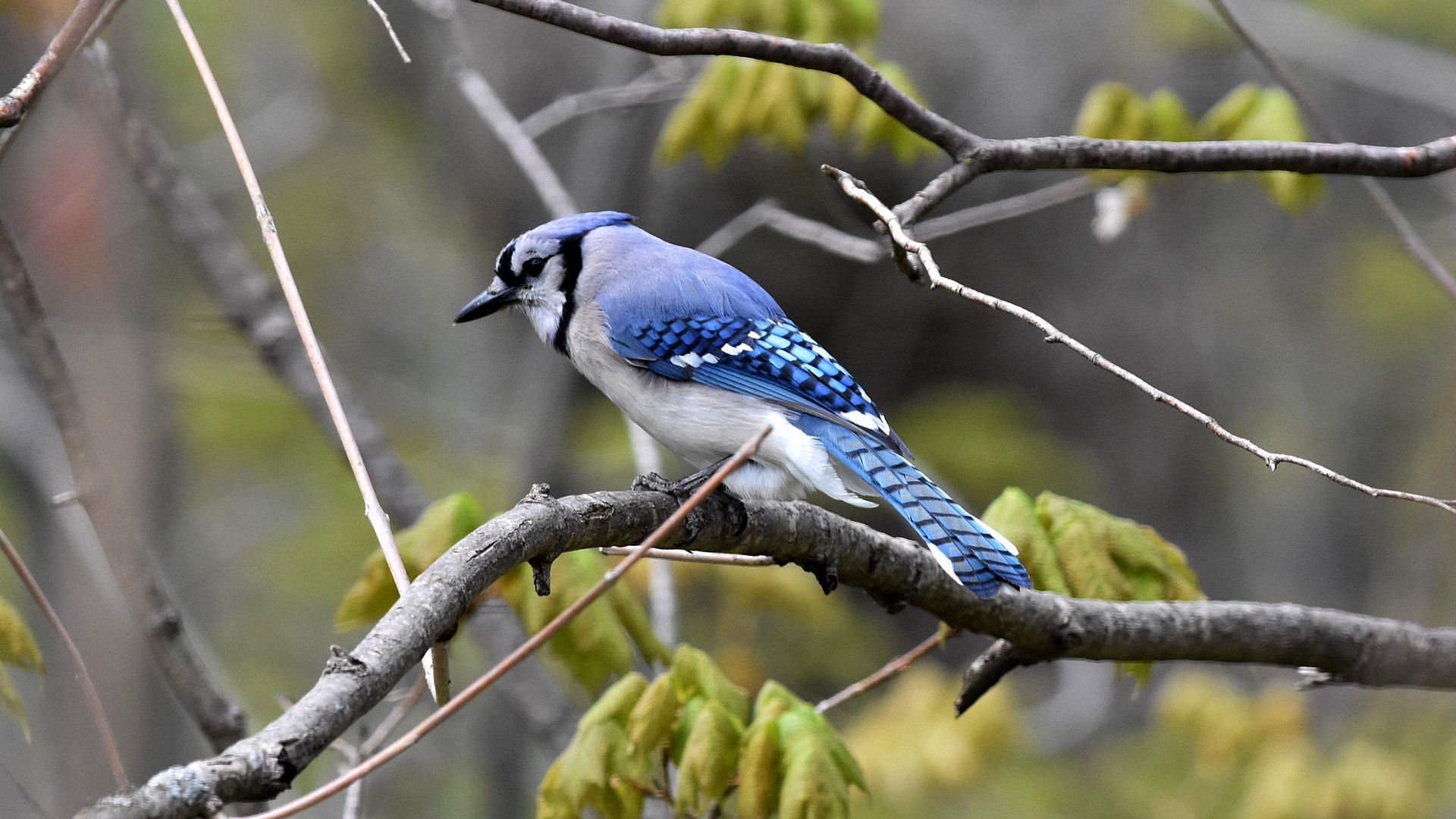
Now that the trees have shed their fall leaves and winter is on the way, I have a new appreciation for the blue jays that visit our feeders. They are a welcome splash of color as they fly boldly about, their feathers a flash of blues, blacks and white. Look closely and you will see a beautiful blue and black mosaic pattern on the wings along with a striking white wing bar. Their bellies are a bright white, and they sport a cocky blue crest on top of their head. A rather wide black necklace encircles the head, and a black streak extends from either side of the eye. Their bill is long, strong and straight.
The blue jay’s common raucous call which to us sounds like “jay, jay, jay” alerts us to his presence. According to the book, “Jewels of Nature, Delightful Birds I Have Known” by Alan Haney, this bird has a wide range of calls. Some are quiet songs composed of gurgles, whines, clucks and clicks probably used for communicating among themselves. Another is described as a “gate hinge” call that sounds like a gate swinging open on rusty hinges and used when a parent perceives a threat near the nest.
Some songs are loud and insistent. You may have heard their loud belligerent “thief, thief, thief” call when they are mobbing (swooping toward, chasing and sometimes striking) larger animals such as owls, squirrels, snakes or other perceived threats, according to Haney.
Blue jays are great mimics as well and can learn to mimic the call of a red-shouldered hawk, a cat’s meow and human speech according to The Cornell Lab All About Birds website, or AAB.
It’s the year-round residents that grace our yards all winter. According to AAB, blue jays are considered resident or short distance migrants. Their range extends from northern Saskatchewan, Canada, to southern Florida and from the east coast to the Rocky Mountains, but it is likely that less than 20% of jays migrate north to south and back across this range.
Haney notes that blue jays are more important than squirrels in spreading plants that produce nuts and seeds. Their expandable throat pouches along with mouth and beaks allow them to carry off 20 or more sunflower seeds or up to five acorns at a time. According to AAB, six birds with radio transmitters each cached (hid for later retrieval) 3,000-5,000 acorns in one autumn.
The nuts and seeds are cached in litter or soil, often in fields, and this, according to Haney, accounts for “the steady march of oaks or hickories into abandoned fields, far from the forest edge.”
Blue jays also eat insects, grains and dead or injured small vertebrates. They sometimes raid nests for eggs and nestlings, but research has shown this to compose only a small amount (1%) of their diet, according to AAB. We know they also like fruit as we watched in amazement one day as a jay carried off a large plum from one of our trees.
The jay’s emotional well being is signaled by its crest. The higher the crest, the higher its aggression level, according to AAB. When a blue jay “squawks,” its crest is almost always up — watch out.
An article linked to the AAB website by Lauren Smith explains an interesting behavior of the blue jay called “anting.” With wings spread and tail tucked between its legs, the jay gently picks up an ant in its beak and rubs it on its feathers before eating it. Research as to why revealed that the bird is likely ridding the ants of a bitter-tasting formic acid that the ant sprays behind it as a defense mechanism. Once the acid is rubbed off, the jay can enjoy a more delectable meal.
Blue jays may appear aggressive at your feeders; their size and raucous calls contribute to this perception. However, there are several birds that can dominate the jays, including red-bellied and red-headed woodpeckers, common grackles, mourning doves and northern cardinals, according to AAB. Then, of course, there are the squirrels that are all over our feeders scattering every bird looking for a meal.
Blue jays are still common, but their populations have declined by about 0.6% per year with an estimated 27% cumulative decline between 1966 and 2019, according to the North American Breeding Bird Survey. One of the biggest threats to the species is predation by cats and dogs, according to AAB. We have the power to control this threat by keeping pets indoors or leashed when outdoors.
To attract blue jays to your yard, use a tray or hopper feeder; they work better than a hanging feeder, according to AAB. Provision it with peanuts and sunflower seeds, add suet and you have a blue jay feast. It’s great to see these brightly colored and vocal birds at our feeders; enjoy them throughout the year — especially this winter, when their bold colors can lift our spirits.
Cathy Carnes is a retired biologist in Oconto who worked with the U.S. Fish and Wildlife Service Green Bay Field Office and, prior to that, with the U.S. Army Corps of Engineers Regulatory Branch in Buffalo, New York. As endangered species coordinator for the USFWS, she helped conserve and recover federally listed threatened and endangered species in Wisconsin.
Blue jays raucous, colorful and interesting