
The United States of America’s 250th anniversary prompts historical conversations.
For many, they’re about examining the country’s Founding Fathers and trailblazers, many of whom are already household names. As a tribal college faculty member who teaches American history, I’m committed to ensuring that Native people are remembered for their contributions to our shared national story.
Being a Wisconsin academic interested in public memory, I believe the 150th anniversary is also worth revisiting for those who call the Badger State their home. In fact, there are interesting parallels between the current occupant of the Oval Office and his 1926 predecessor.
Like President Donald Trump, Calvin Coolidge liked to escape the confines of Washington, D.C., to enjoy recreation during the summer months. Whereas Trump often retreats to the golf course at his Mar-a-Lago Club in Palm Beach, Florida, Coolidge sought five separate “Summer White Houses” while he held the nation’s highest office. They include Plymouth Notch, Vermont, in 1924, Swampscott, Massachusetts, in 1925, and Paul Smiths, New York, in 1926.
Prior to his departure in 1926, Coolidge stated in a mid-June press conference, “I don’t go away from Washington for the purpose of avoiding the Washington climate so much as I do for the purpose of getting a change.”
I suspect the president’s affinity for fishing also contributed to his annual exodus.
In 1927, Coolidge’s love for angling brought him to the Black Hills of South Dakota. That summer not only led to the naming of Grace Coolidge Creek in honor of the first lady, but it also garnered the president’s support for the creation of the Mount Rushmore National Memorial.
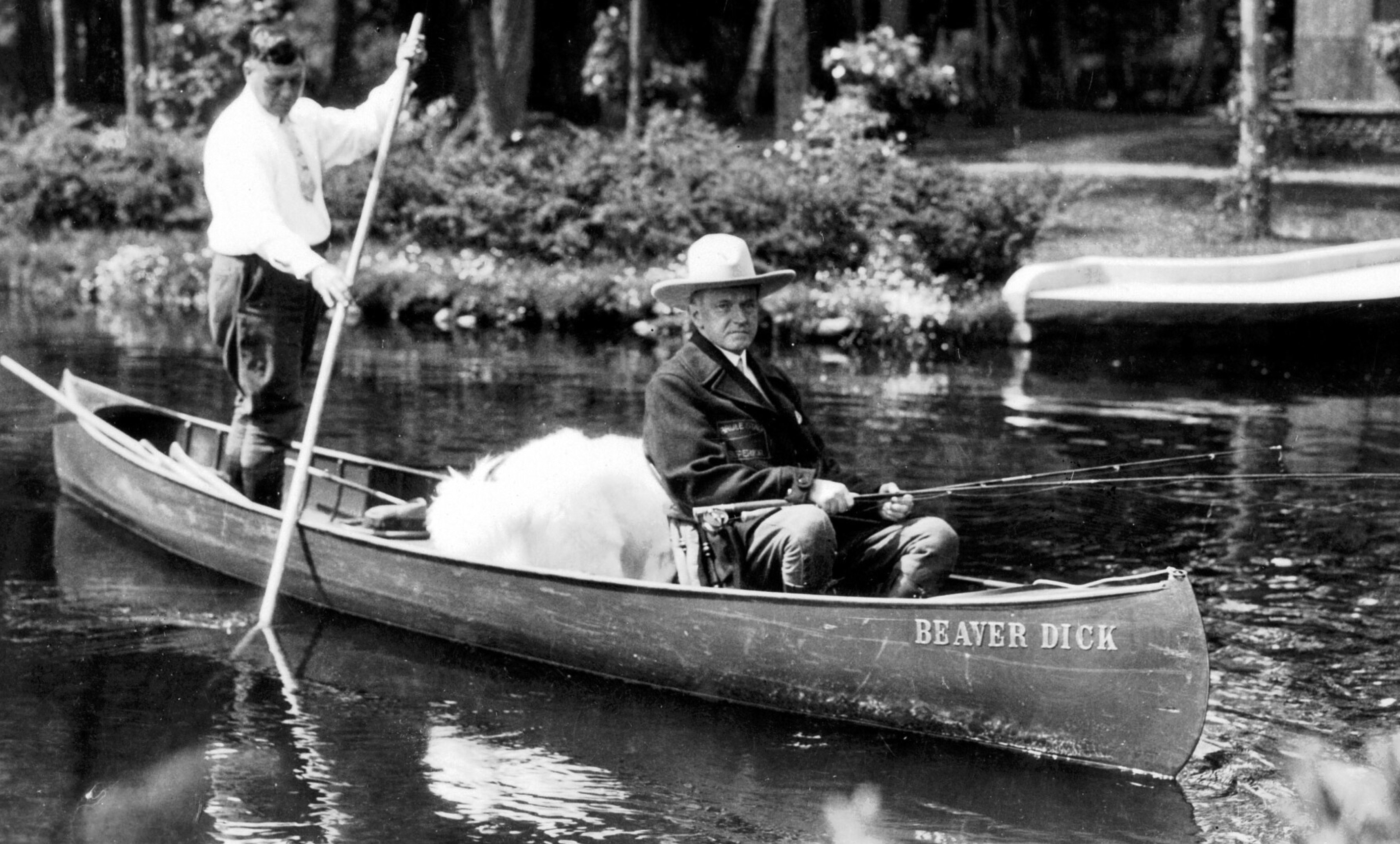
Yet, it’s the summer of 1928 that is likely the most interesting for Wisconsinites and Native historians alike, as Coolidge spent it in Henry Clay Pierce’s Cedar Island Lodge along the riverfront of Brule, Wisconsin. In his downtime, the president fished those fruitful waters with Bad River Ojibway tribal member John LaRock as his guide.
Public records note that LaRock was born in 1873 and that he had received allotments of tribal lands in both 1919 and 1927. LaRock was married with two adopted sons at the time he captained Coolidge’s canoe, making the 55-year-old a seasoned, relatable companion to the married president with two sons, who was one year his senior.
Assigned to Coolidge by the state conservation committee, LaRock also “spoke quietly,” which likely appealed to the president whose frugality with words led to him being referred to as “Silent Cal.”
LaRock emphasized the virtues of his charge’s even-keeled demeanor, telling the Associated Press, “Doesn’t get excited, not a bit. Good fisherman, President Coolidge.”
Wearing “a big cowboy hat and high-heeled boots,” Coolidge rode in the front of LaRock’s canoe with a second “canoe with three secret service men” joining them on the river.
Using “both worm and fly in his angling,” the president “spent many days whipping the waters” to “snare the wily German brown, rainbow and speckled trout.” Whether through good fortune or consummate skill, the duo “invariably returned to the lodge with overflowing creels.”
LaRock offered to make Coolidge his own canoe for their future expeditions together.
“Soon,” LaRock said. “I will have a birch bark canoe ready for the president. He likes the canoe very much and we will use it for the trips when I get it finished.”
Perhaps in preparation for the United States’ bicentennial, the Wisconsin Historical Society erected a marker titled “Summer White House — 1928” in Brule in 1975. It notes that Coolidge welcomed his successor, Herbert Hoover, to the site on July 16, 1928, making it the latter’s first public appearance after securing the Republican nomination for the presidency. Regrettably, the marker makes no mention of John LaRock.
Just as stories of George Washington’s Continental Army’s survival at Valley Forge cannot be told without naming the Oneida cook, Polly Cooper, who fed the starving soldiers the white corn she prepared for them, Coolidge’s escapades to Wisconsin waters should not be shared without emphasizing the role John LaRock played.
As the Smithsonian undersecretary for museums and culture, Pawnee tribal member Kevin Gover stated, “We get to decide, generation by generation … what to remember and what to forget.”
My fellow Wisconsinites, let’s add John LaRock, President Calvin Coolidge and Wisconsin’s Summer White House to the stories we share this year. The United States has 250 years’ worth of history, and the country is all the richer when it remembers the contributions of Native Americans at every milestone.
Ryan Winn, Ph.D., teaches communications, English, history and theater at the College of Menominee Nation. Visit www.menominee.edu for more information about the school.


