
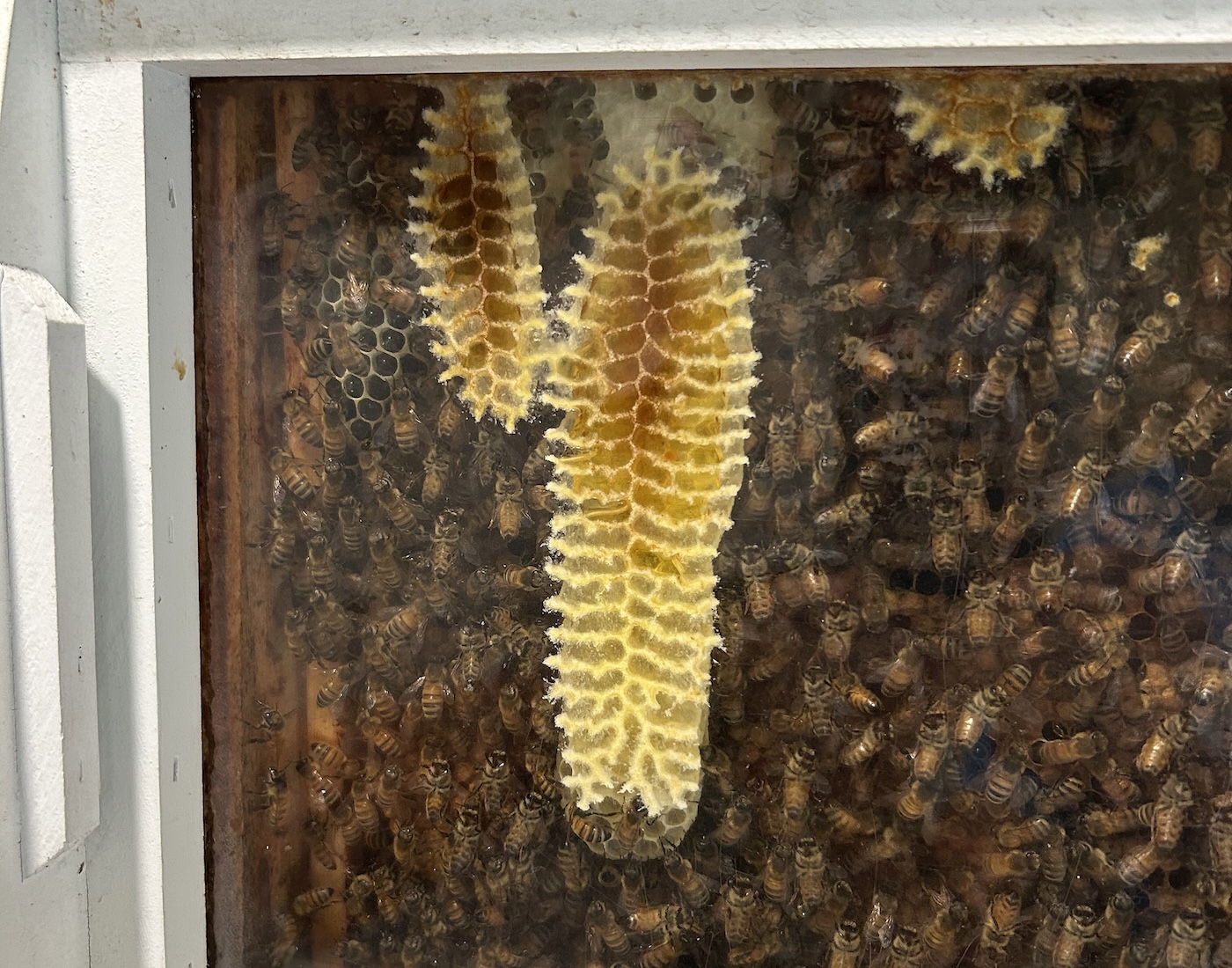
In rural Shawano County, the bees are busy making honey at John and Lorraine Ballbach’s Hobby Honey Farm in Gresham.
However, their farm offers more than raw honey.
In addition to selling local raw and creamed honey, the Ballbachs also sell their own beeswax products which include tea lights, votive cups and candles as well as beeswax bars.
Beeswax bars can be used as a lubricant, a sealant, used for cutting boards and for cabinetry — even for ease of opening windows and drawers.
“My customers have taught me how many uses they come up with for beeswax bars,” said Lorraine Ballbach. “They use it to season cast iron pans and bowstrings for their bows, and to lubricate guitar strings.”
Bees make the wax, gorging themselves with honey, extracting the wax out of their abdomen. The wax is then scraped out of the frames, and Lorraine Ballbach melts it, pouring it into 5-cup mold trays.
“We keep bees throughout the state of Wisconsin and Upper Michigan for specialty honeys. We have 24 Michigan hives we tend,” said John Ballbach.
Bees carry pollen back to the hive and produce honey. Each source reflects the flavor from where it came. Some come from the buckwheat plant, others from the basswood tree and still others from wild flowers.
All the honeys at the farm are labeled and named after the source.
For example, Starthistle is from the thistle plant. It’s a light-brown, caramel-tasting honey, velvety and smooth. Summer Blend is a conventional honey and what the bees put in the box from spring to fall. Buckwheat honey is black and has a syrupy, molasses taste with 20 times the antioxidants of any light honey. Honey from basswood has a stronger flavor, with a light mint taste.
The honeys are stored separately in water-jacketed stainless steel tanks, with the water kept at 90 degrees.
“Otherwise, sitting long enough, raw honey will granulate,” said John Ballbach.
The family has downsized to 100 hives this year from approximately 230 because of health issues and age.
“My dad used to run 650 hives here in addition to 40 head of beef cattle and work the land well into his 70s,” said John Ballbach. “We grew up in southern Wisconsin near Port Washington and bought this property in 1989. He brought the bees with him. He was a migrant beekeeper, spending winters in Florida and summers in Wisconsin, packing the bees up in a semi and taking them with him.”
Since there is a lot of misinformation on the internet, John Ballbach stresses getting correct information first-hand from a seasoned beekeeper if anyone has a notion to start keeping bees.
“Ninety percent of the stuff out there is false. I tell people what not to do, and they do it and they wonder why it didn’t work out even though they saw it on YouTube,” said John Ballbach.
After marrying, the Ballbachs only had one hive. In 2008, Lorraine Ballbach quit working because of health issues. After making a list of things she could do, she discovered one was making honey. For one year, they researched the ins and outs of selling raw honey.
“The next year we got 25 more hives, and it just kept going up from there,” said Lorraine Ballbach.
The Ballbachs don’t have any helpers on the honey farm.
“It takes dedication. You can’t let the bee stings bother you; you gotta love the bees,” said John Ballbach. “You can read all the books you want, but there’s no learning like hands-on experience.”
Conditions like the weather and which plants are necturing determine how much honey is made. Mid-summer, weather depending, bees make 80% of the honey they make in the year. Basswood trees’ blooms hang down so that when it rains, it doesn’t wash the nectar out of the flowers. Those trees start blooming around the Fourth of July, and if the conditions are favorable, the bees can fill a 10-pound box in a day.
“It started out slow, but it’s shaping up well this year. The rains have been excellent for maintaining sweet and Dutch clover. A huge crop all came at once. The sweet clover is exploding everywhere. This year, everything is ready at the same time,” said John Ballbach.
The Ballbachs take a small observation hive along to their farmers markets — encased in clear plastic — so customers can see inside the hive and observe the bees at work. They also use it for teaching 4-H groups or schools that ask the couple to come and speak.
If the bees need to make heat, they’ll consume honey and shiver to contain heat, keeping the brood warm — between 92 and 95 degrees. If it gets too hot, they’ll haul water into the open cells and fan it so it evaporates to cool.
“We work hard to provide a good product. Quality is a big thing,” said Lorraine Ballbach. “For example, I test all my candles before I sell them. I expect quality from others, so I want to offer a quality product. Every year, I think of something new to sell.”
Sales are conducted directly on farm located at W9790 Thurner Lane, Gresham, and also at area farmers markets. For more information, like them on Facebook at John and Lorraine’s Hobby Honey Farm.
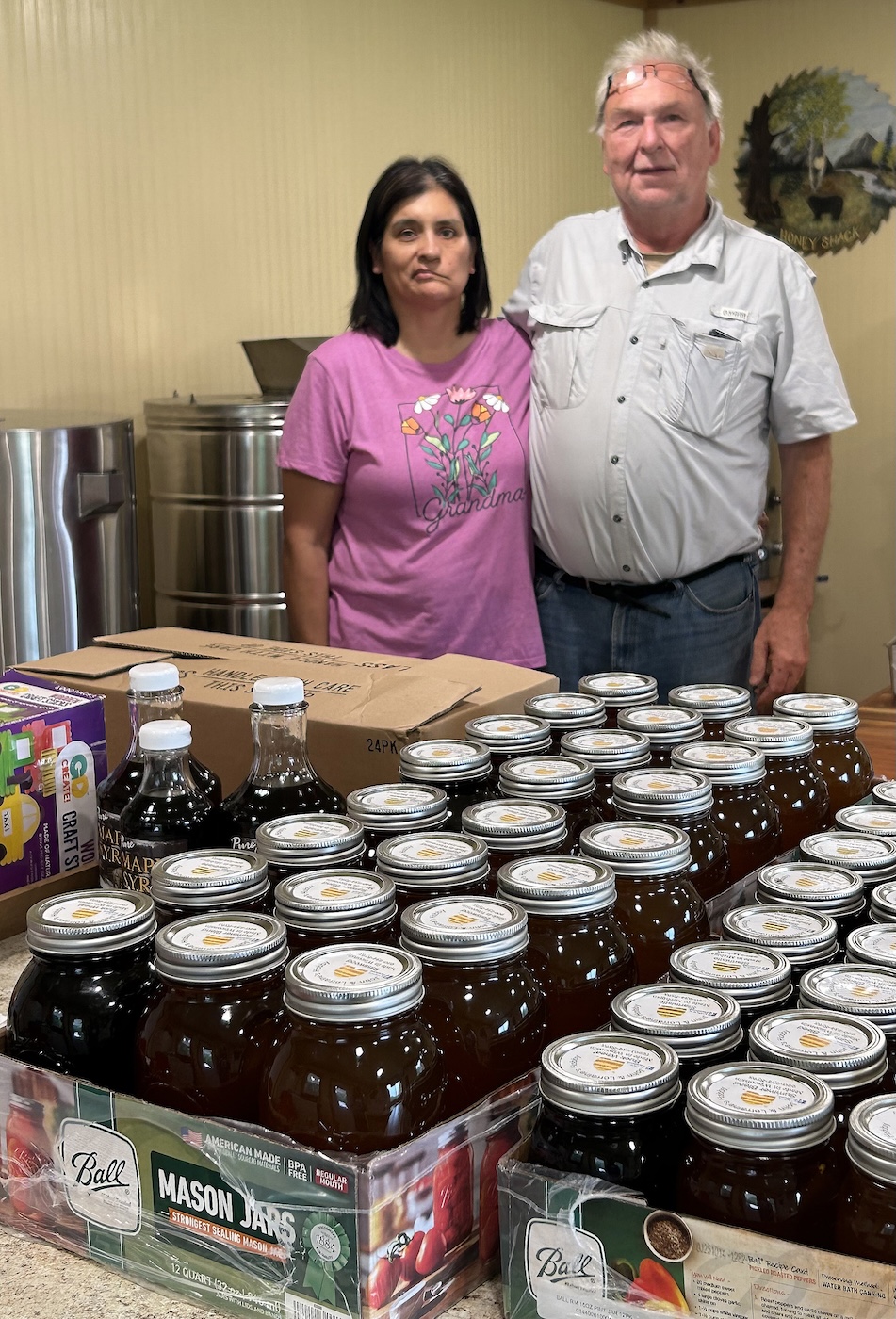
Owners John and Lorraine Ballbach pose before their specialized honey at their Honey Hobby Farm located outside of Gresham. (Kay Reminger)


