
Menominee elder Sylvia Wilber taught me that there’s a truism behind the motivations about the United States’ Native American policies: “It’s all about the land.”
From treaties, to relocation, to removal, to termination, to pipelines, to mines, to nuclear waste repositories, to carbon credits, the government-to-government relationship defined in the U.S. Constitution and upheld by the Supreme Court has historically been exercised on all matters concerning Native land. When Native people own it, someone else wants it.
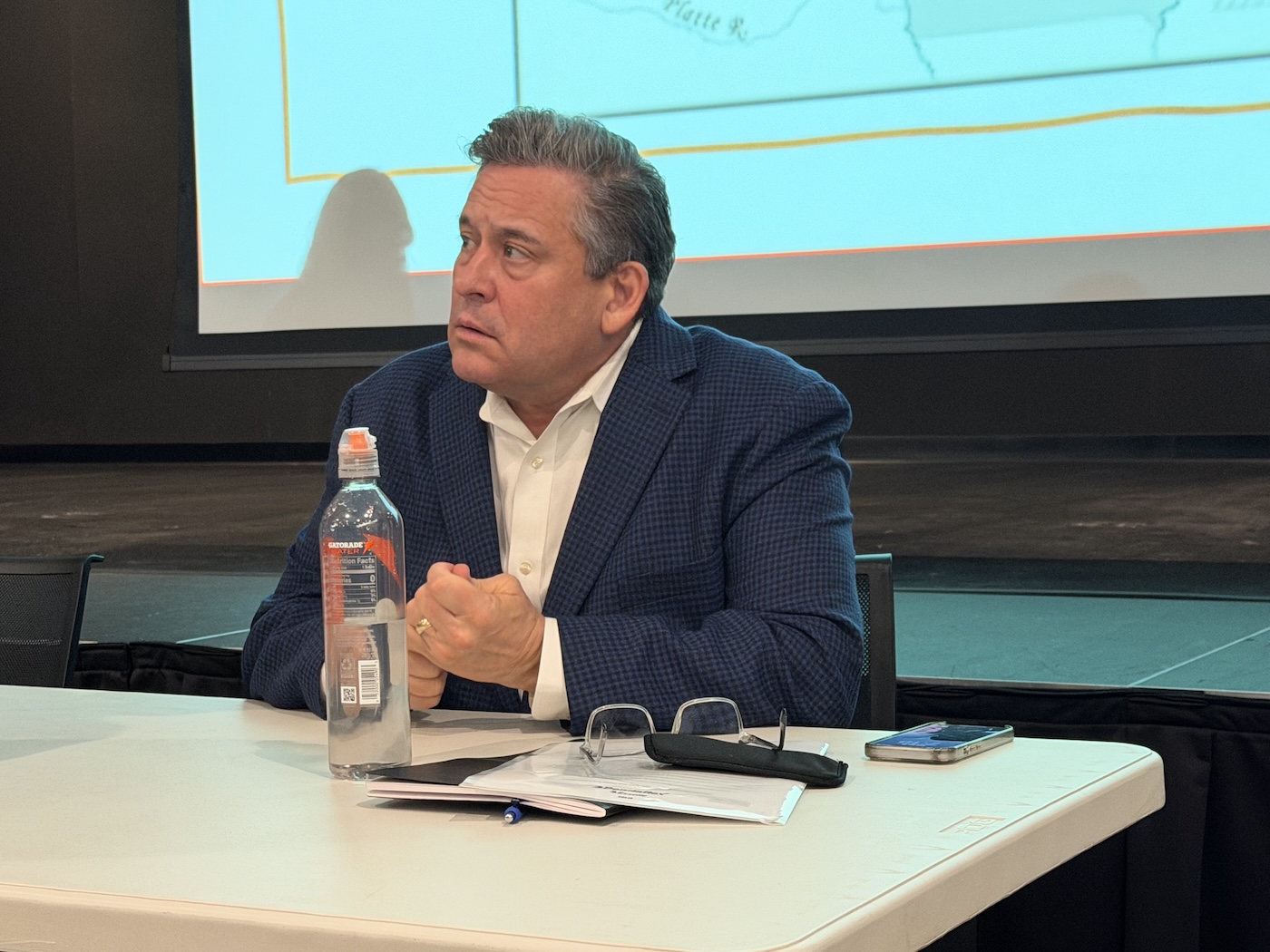
Red Cliff Band of Lake Superior Ojibwe tribal member Michael Witgen delivered the James Madison Lecture at the Brown County Library last month, affirming the reality that what some see as distant history has ongoing consequences for modern Americans.
Titling his presentation “Native Land and the American Revolution,” the professor of history at Columbia University noted in his pre-lecture postcard that “European empires established colonies in North America around the idea of ‘discovering’ a so-called New World. In reality, these lands were already home to Native people with long histories, governments and cultures.”
A 2023 Pulitzer Prize finalist author of “Seeing Red: Indigenous Land, American Expansion, and the Political Economy of Plunder in North America,” Witgen sought to clarify some of the historical realities about the dispossession of Native land.
Witgen began his talk by highlighting that John Locke’s 1689 claim that “God, when he gave the World in common to all Mankind … (and) commanded him to subdue the Earth” held sway with the colonists. Locke’s literal or proverbial ideas offered non-Natives a rationale to seek dominion over Native land despite the “fully formed societies of Native Americans” that thrived there.
Quoting Presidents George Washington and Thomas Jefferson, “the Father of the National Archives,” J. Franklin Jameson, and influential early 20th century Wisconsin-born professor Fredrick Jackson Turner, Witgen charted how the myths of Native people “vanishing” were used as partial justification for the conquest of Indigenous nations’ resources.
“The treaty process was the easiest way to transfer land, offering a veneer of legitimacy,” Witgen said. “The United States did not engage in the treaty process in good faith, but rather to extract wealth, resources and land from Indigenous populations.”
In 1837, the first governor of what was then the Wisconsin Territory, Henry Dodge, led the charge to secure some of the homelands of Witgen’s people.
“Wisconsin Territory created very little clamoring for Ojibwe land, but the immense pinery was desired,” Witgen said.
The Ojibwe wanted to retain their land, noting that they hoped to continue to hunt and fish upon it. Recognizing the looming threat of Andrew Jackson’s Indian Removal Act of 1830, the Ojibwe proposed that they’d be willing to lease their lands before ultimately being forced to relinquish them.
Dodge did implore “executive privilege” to note that the Ojibwe retained hunting and gaming rights on their former homelands. Dodge’s acquiescence to Ojibwe wishes set the stage for the 1987-1991 Wisconsin Walleye Wars where non-Natives accosted Ojibwe anglers who exercised these retained sovereignty rights.
The Morrill Land-Grant Act of 1862 provided the legislative means for New York business man Ezra Cornell to buy “499,900 acres” of the ceded Ojibwe land to use as an endowment for Cornell University. Witgen conveyed that the eventual sale of those lands yielded $574 million for the Ivy League school.
Cornell was one of 52 land-grant beneficiary institutions that collectively bought 11 million acres of Indigenous land dispossessed from 250 nations. At least 16 of those institutions still hold some rights to those lands, including Cornell’s ownership of mineral rights to 300,000 acres of formerly Ojibwe land in Northern Wisconsin.
Cornell’s holdings include the Barron Country Hills Pipestone Quarry, which the Lac Courtes Oreille Ojibwe used to craft pipes for Midewiwin religious ceremonies. While it’s unlikely anyone will start mining the site anytime soon, the university is unwilling to return those rights to the people who believe that the pipestone offers them a means to interact with their creator.
After his address, an audience member asked how the story of the Ojibwe people’s land loss compared with local Native nations, including the Menominee people whose ancestral homelands include the land we were gathered upon.
Witgen stated that what happened to the Ojibwe was not anomalous, and that “the Menominee have a similar experience.”
Later, one of my students who couldn’t attend asked what Witgen’s lecture was about, and I provided him with a summary not unlike the one I now share here with our readers.
To put it succinctly, I told him it was all about the land.
Ryan Winn, Ph.D., teaches communications, English, history and theater at the College of Menominee Nation. Visit www.menominee.edu for more information about the school.


