
When I was a young child, I lived on the last block at the edge of town. Beyond it lay rolling hills that beckoned me to explore. I considered them my playground. One experience has stayed with me for more than half a century.
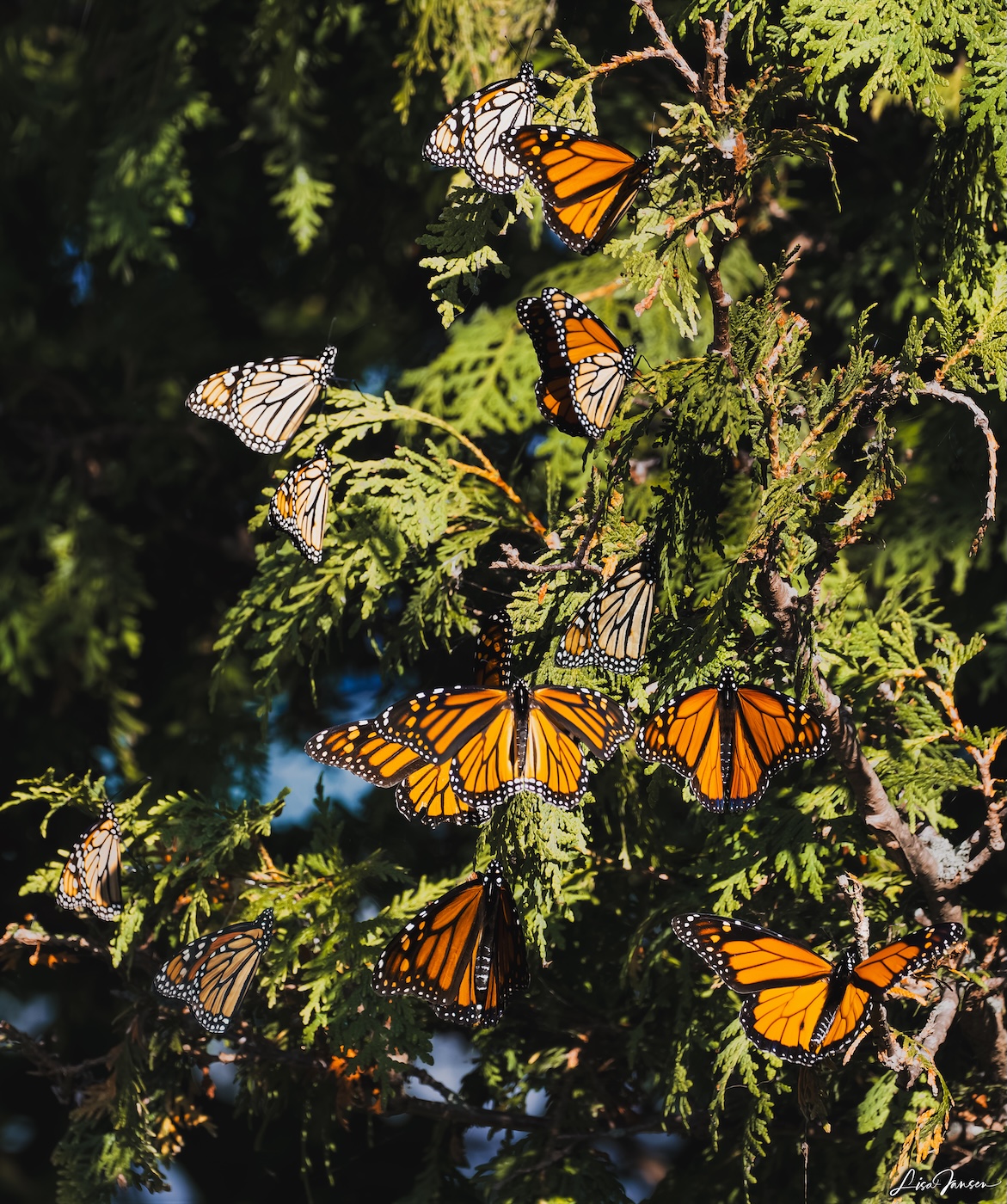
One day, I ventured over the third hill, farther than I had gone before. There stood an extraordinary tree. I remember thinking I had stumbled into heaven. The tree was drenched in orange, not from its leaves but from what rested upon them.
Looking closer, I realized that every branch seemed blanketed with monarch butterflies. Their wings were closed, and they were packed so tightly together that it was difficult to distinguish one from another.
I knew what a monarch was, but I had never seen them gathered in such astonishing numbers. The sight was beautiful, unbelievable and mesmerizing. I didn’t understand what I was witnessing, but I have felt a special connection to monarchs ever since.
Years later, I learned that the final generation of monarchs each year, known as the “super generation,” migrates south and clusters together like this on trees throughout the winter. Monarchs that live east of the Rockies migrate to Mexico’s oyamel fir forests, while those from the Northwest overwinter in California’s coastal groves.
Reaching Mexico’s monarch colonies requires planes, buses, donkeys, and mountain hikes, so I hoped to see monarchs roosting in California instead. That opportunity came during a birding festival last January, when I heard about an overwintering refuge near my lodging. I set out to see my miracle monarchs again.
I planned to arrive before the sun warmed their wings for flight. I imagined sagging branches covered in butterflies and wondered how I might photograph their overlapping wings. I was over the moon with excitement, feeling like the adventurous young girl who had first discovered them.
When I arrived, cars filled the parking lot, yet not a speck of orange or black appeared. No monarchs in the trees, sky or on the ground. Not one. I was heartbroken. I knew their numbers were declining, but I hadn’t expected this. Later, I learned they had simply chosen another location that year.
As I continued learning about monarchs, I discovered something I’d overlooked for years — the super generation congregates not only at wintering grounds but also along its southern migration route. The butterflies seek sheltered roosting spots based on wind protection, water, nectar and suitable trees. Sometimes they return to the same trees their ancestors visited the year before. The butterflies that covered that tree in my childhood memory were migrating monarchs.
That discovery sparked a question: Could I experience my monarch miracle again, closer to home? To my amazement, I learned that hundreds, sometimes thousands, of monarchs gather during their fall migration at the southern tip of Michigan’s Stonington Peninsula, just a few hours away.
So off I went.
While there, I met Opal Hoffman, a dedicated community volunteer who educates visitors, organizes volunteers, tags monarchs and shares updates in the Facebook group Monarch Butterfly Migration on Stonington Peninsula. She explained that favorable wind and weather conditions funnel migrating butterflies down the peninsula over Lake Michigan to Door County.
Upon arriving, the monarchs remained clustered in the trees, too cold to fly. But as sunlight touched their wings, they seemed to come alive. One by one, they began to flutter, rising into the sky like heavenly orange angels. My spirit lifted right along with them.
Stonington Peninsula participates in monarch research. Through Monarch Watch, volunteers attach tiny, coded stickers to monarchs’ hindwings. This season, Hoffman and fellow volunteers tagged more than 500 butterflies at the peninsula. Researchers use the tags to learn about migration routes, geographic origins and survival rates. If you spot a tagged monarch, you can report its code at monarchwatch.org/tagging.
Researchers also track monarchs through Project Monarch’s BluMorpho program. They attach tiny, solar-powered Bluetooth transmitters onto the monarchs’ thorax. Any cell phone with the free Project Monarch Science app installed can act as a mini-receiver. You do not need to physically see the butterfly or point your camera at it. If a tagged monarch flies within Bluetooth range, its signal is detected and the data is automatically logged, processed and mapped.
Together, these initiatives help researchers identify important habitats and stopover sites, guiding conservation efforts.
For me, the research is fascinating, but the greatest reward is discovering that childhood wonders can come to life again, sometimes closer to home than we imagine. This time, I understood a little more of the miracle before me.
The next time you see a monarch, take a moment to appreciate not only its beauty but also the remarkable journey unfolding just beyond your backyard.
Lisa Jansen is a Wisconsin master naturalist, nature writer, and award-winning photographer. She specializes in raising awareness of birds and butterflies of the Midwest.


