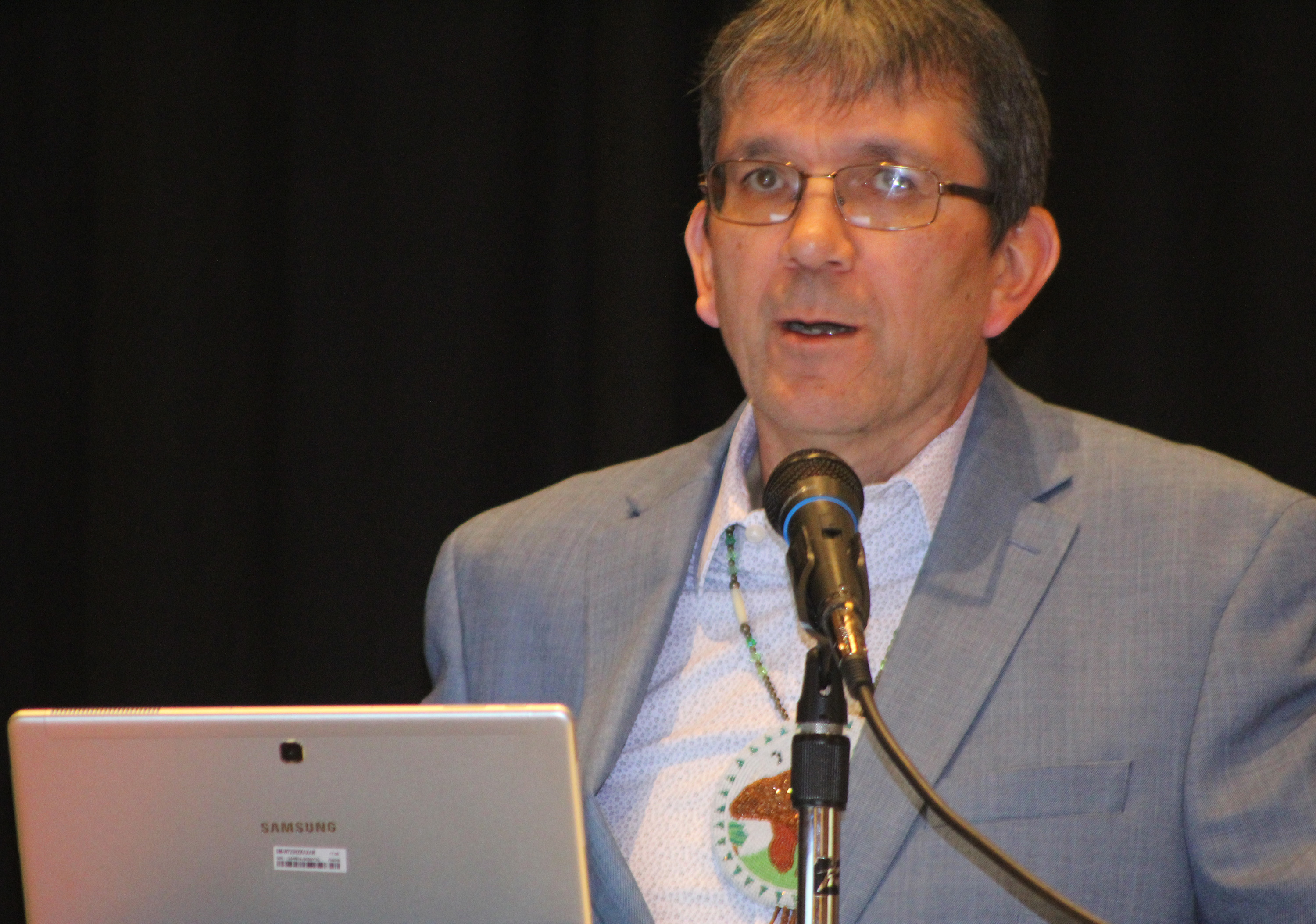
KESHENA — A budget shortfall due to lagging casino profits and a partial government shutdown hit the Menominee Indian Tribe of Wisconsin hard in 2019, but the tribe still intends to move forward on several key building plans in the new year, according to tribal chairman Douglas Cox.
Cox gave his annual State of the Menominee Nation address Saturday at the Menominee Casino Resort during the Menominee Indian Tribe Annual General Council. He said that 2019 was a year with both advancements and setbacks. Among the setbacks were the revenues that came in from the casino itself, he said.
“We have been severely impacted in our finances,” Cox said, without giving specific numbers on how short anticipated revenues from the casino were. “The tribal government, which depends heavily on those revenues from our gaming operations, felt sudden fiscal pressures by tapping into reserve funds and cutting spending.”
However, the tribe also found itself having to act on budget contingency plans when the federal government was shut down right before Christmas and stayed closed until Jan. 25, 2019, one year to the day of Cox’s tribal address. The 35-day shutdown was the longest in United States history.
“The partial government shutdown from the federal government impacted federal requirements that provide services to our tribe,” Cox said. “Each of the tribe’s departments created budget and operational contingency plans.”
One of the tribal departments not impacted as badly was health, according to Cox, as the tribe’s clinic was able to remain financially solvent. He credited the clinic’s leadership with coming up with revenue sources that allowed it to continue to tend to the reservation’s medical needs, including treatment for opioid addiction.
The tribe is utilizing federal grants to train its police department and health officials to handle mental illness. The clinic saw an increase of 3,000 visits to the clinic in 2019, with a total of 20,569 for the year, Cox claimed, and in the process decreased the number of narcotics prescribed by over 40%.
“That’s a huge accomplishment,” Cox said.
The tribal chairman then reported that plans for a 60,000-square-foot family and community engagement center would contribute further to his culture’s good health. The center is expected to break ground this summer.
“We’re making the health of our youth a visible priority in our community,” Cox said.
The center will include two NCAA-sized basketball courts, he said, along with a fitness center, fitness studios to accommodate the tribe’s boxing club, program areas for the tribe’s youth services and an indoor walking track.
The tribe is also looking to expand its tribal business enterprises through its Wolf River Development Company. Construction is expected to begin in spring on Bay Bank, the reservation’s first bank. A new convenience store and car wash is expected to break ground in the summer.
Cox continued to tout efforts to file a new application with the state to approve a Menominee casino in Kenosha. He said he believes such an application would succeed under Gov. Tony Evers’ administration. The tribe attempted an application under former Gov. Scott Walker’s administration, but Walker rejected it in 2015.
“We believe Gov. Evers would be receptive to a Menominee Kenosha gaming project,” Cox said.
The tribe is also working to bring back its language and culture, according to Cox. The tribe has only four fluent Menominee language speakers, but through its efforts and immersion programs, there are 17 tribal members certified to teach the language.
“Learning the language from our grandparents, parents and elders is the ideal situation,” Cox said. “At this time, this is a struggle for us because of the loss of our first language elders and speakers.”
Cox also reported some negatives in race relations, pointing out the controversy in October when four Clintonville High School students performed a mocking Native American dance that was posted to social media and caused outrage among many area tribes. He noted that since the incident, there have been some positive dialogues to promote better understanding of the Menominee and other unique cultures.
Another negative that turned into a positive came from the Menomonee Falls School District’s decision regarding its native mascot. After two months of contentious debate, the district’s board voted in December to end its affiliation as the Indians and plans to utilize high school students to consider a new nickname.
There have also been positive race relations, according to Cox, including Menominee recognition ceremonies in Green Bay and Oshkosh. Also, a statue portraying an ancestral bear has been erected in Marinette at the mouth of the Menominee River, expected to be followed by plans for a future monument paying tribute to all five of the Menominee’s primary clans.
The Menominee Tribal Legislature has also had to contend with controversy in its law enforcement. After voting in 2018 to remove its elected police chief, Mark Waukau, from office, it has debated whether appointing a police chief would be a better decision. The legislature decided against that measure, according to Cox, but it created a commission to oversee the police department.
“We will be moving forward with the election of the tribal police chief in the very near future,” he said.
Despite the tumultuous year, Cox believes that every decision has advanced the tribe in some way.
“Every decision we’ve made has been in the best interest of our Menominee Nation,” Cox said. “We have our own judicial system. We operate our own police force. We run our own school, administer our own clinic, and we operate a number of business enterprises. We have much to be proud of.”
lpulaski@newmedia-wi.com
Tribal address points to new construction plans