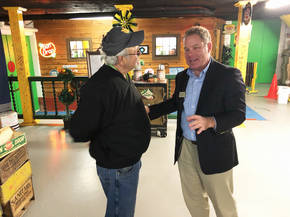
SHAWANO - State Supreme Court Justice Dan Kelly brought his thoughts on the judiciary to Shawano Thursday as part of his campaign to stay on the bench.
Kelly spoke to a group of about 30 supporters at the Seasons restaurant.
Kelly was appointed to the high court in 2016 by then-governor Scott Walker to complete the term of Justice David Prosser. He faces election for a full 10-year term, starting with an April 2020 primary against Dane County Circuit Judge Jill Karofsky and Marquette University Law School professor Ed Fallone. The top two vote-getters face off in the November general election.
He said the court is now divided into five conservatives and two liberals, but there are really only three of what Kelly called “constitutional constructionists.” Kelly counts himself among the constructionists, insisting on a strict interpretation of the text of the state constitution.
He was interrupted in his analysis by a question on Justice Rebecca Dallet, a self-described liberal. Dallett defeated conservative Michael Screnock in 2018.
Asked by one of the attendees if Dallett was rigid, Kelly laughed and said, “Yes, she’s rigid. I get along with her personally but we’re miles apart on the law.”
Kelly offered that Shirley Abrahamson, a former chief justice who left the court this year, was the most activist judge ever and that Dallett wants to be the next Abrahamson on the court.
In his public remarks about his heroes, Kelly said, “I am not committed to a person. I am committed to the text of the constitution.”
In remarks to the Shawano Leader, Kelly amended his thoughts, singling out Richard Abell, a federal judge, as a great mentor. Kelly served as a clerk for Abell during his second year of law school.
Kelly also admires U.S. Supreme Court Justice John Marshall. Kelly said, although Marshall served as Chief Justice nearly 200 years ago, “A lot of what I say in opinions comes from him.” Kelly said he admired Marshall’s rigorousness of thought. “He believed not only in the courts upholding the legitimacy of the constitution but that the courts are seen as following the law.”
In particular, Kelly liked that Marshall established the practice of a single opinion from the high court with justices agreeing or disagreeing in separate documents. He said that cemented the idea that the court spoke with a single voice, reducing confusion.
On the contemporary U.S. Supreme Court, Kelly said he saw Justice Clarence Thomas as one of the great strict constructionists and liked that Thomas is faithful to the constitution, seeking out the historical meaning of the text.
Kelly also finds a great deal in common with recently-appointed Justice Neil Gorsuch. He sees a common link with how Gorsuch writes opinions in plain language, avoiding a lot of legal jargon. “The people of Wisconsin are asking me to exercise their authority for them. I want my opinions to be easily understood,” Kelly said. He does not require the reader to be a lawyer, he added.
In the first debate of the state court race, Kelly was attacked for ignoring court precedent this year by overturning a 2016 decision. In the new decision, the court majority found that the state Superintendent of Public Instruction (SPI) cannot set education policy without permission from the governor.
This raises the role of legal precedent, an issue aired during the recent confirmations of Gorsuch and Brett Kavanaugh to the federal high court.
“On a general level, the idea of precedent is important. The people have an expectation that the law be consistent. They have to be able to order their lives,”Kelly said
He continued, “But the more important thing is to follow the law. Precedent doesn’t mean keeping a mistake alive.”
He said the SPI case was an example of such a mistake, requiring him to look back to older precedents. “When a decision is manifestly wrong, we have to overturn.”
The case also allowed him to affirm one of his deepest convictions, that courts are only to follow the law and not to legislate.
“You cannot diminish legislative authority,” he said. He characterized the implication for the SPI is that Carolyn Stanford Taylor, the current superintendent, only has to go through a couple more steps as a result of the decision.
Kelly underscores strong conservative beliefs in re-election campaign