
Folks looking to the sky when ducks fly by might see some that have been tagged by the Wisconsin Department of Natural Resources.
DNR wildlife technicians like Roberta Bushmaker put bands on birds all over the state. Bushmaker recently completed another round this summer helping to tag mallard and wood ducks to keep track of populations in places like the Navarino Wildlife Area.
Bushmaker’s work keeps her in the Lower Wolf Work Unit, which includes Shawano and Outagamie counties, as well as portions of Winnebago and Waupaca counties.
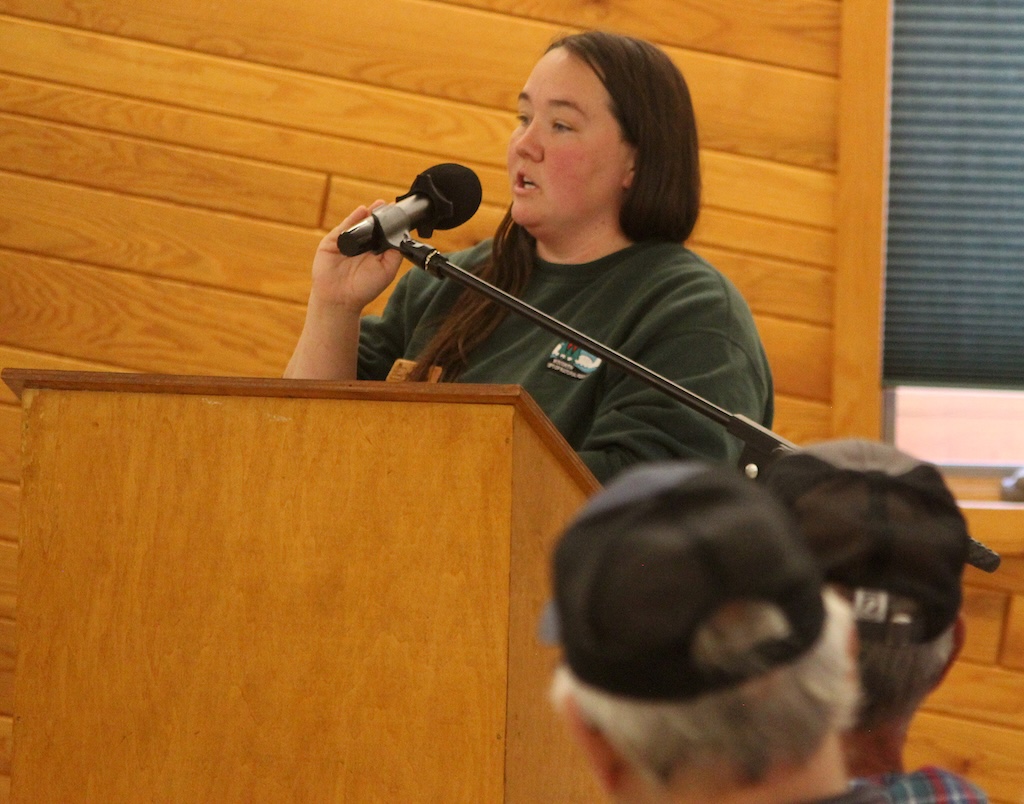
“We band waterfowl, doves and all sorts of birds for population estimates,” Bushmaker said Sept. 4 at a gathering of seniors at the Navarino Nature Center. “For ducks and geese in particular, we set season lengths, bag limits. We work our regulations around them.”
To band the ducks, the DNR must first trap them. Bushmaker said there are several ways to trap them, but the Navarino Wildlife Area utilizes walk-in traps. The ducks pass through a door to eat some bait, but then they can’t get out the way they came in.
Bushmaker noted the DNR in the Navarino area once tried night lighting around Shawano Lake, where spotlights were used to surprise the ducks into nets. Then they were taken to DNR officials and volunteers who put plastic bands on the ducks’ legs. However, that method was not very effective, and it was decided to stick with the walk-in traps.
“We have a bunch of flowages with narrow dikes,” Bushmaker said. “We’ve got three different variations.”
Navarino had previously only used Y-traps, with three entryways for the ducks, according to Bushmaker. The Y-traps were switched out in 2021 for V-traps, with two entryways, because the ducks are usually coming from one side due to cattails and grass prevailing in the pond area. Bushmaker pointed out the ducks prefer open spaces versus areas where other animals can hide.
Z-traps are also set up in Navarino, according to Bushmaker. She said the Z-traps and V-traps tend to catch the most birds.
The DNR usually sets a goal of banding 300 each of mallard and wood ducks. Bushmaker said the Navarino count was only 36 in 2024 and 50 this year.
“I don’t know what happened to the mallards the last couple of years, but it’s got to get better again,” she said.
Although the banding process begins in July and early August, the planning for what to do starts one month earlier, according to Bushmaker. This includes shucking and bagging corn for storage and then eventual placement in the traps. She noted that ducks don’t like husks, so the shucking is necessary in order to trap them.
Prep work also includes mowing by waterways where there is tall grass, usually in June in preparation for setting the traps in July, according to Bushmaker. The timing of setting the traps is critical.
“We found that if we scare the birds prior to 9 o’clock-ish in the morning, those ducks typically don’t come back for quite a while. They’re too skittish then,” Bushmaker said. “For some reason, after 9 o’clock, like midday, they’re fine with whatever’s going on. Then we know we can go out; we can mow. We can just be in the area. They don’t care.”
Officials make sure the traps are filled with corn, as checking the traps happens more on Mondays and Thursdays.
“We want it to look like the yellow brick road,” Bushmaker said. “It’s super inviting for the ducks.”
The downside to using corn is that the traps will usually be attractive to raccoons, as well. Bushmaker said 36 raccoons were trapped in Navarino last year, the most ever. However, the raccoon count was only 11 this year.
Bushmaker said that the bands also help to track where birds migrate. She noted that one duck banded in 2005 was found 10 years later in Georgia. A lot of the birds migrate north to Canada or south to Texas, she said.
lpulaski@newmedia-wi.com


