
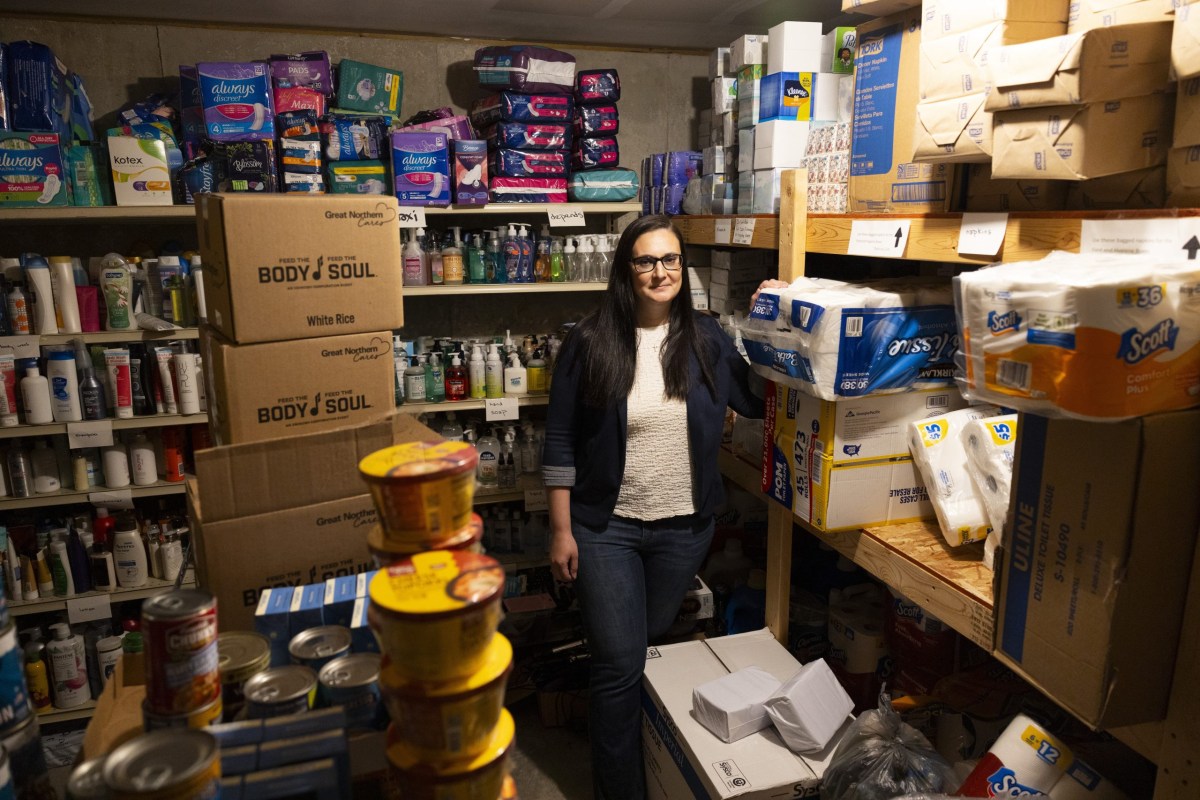
It’s been more than three months since the anti-poverty nonprofit Newcap closed, laying off 90 employees and leaving more than 100 low-income households on the brink of homelessness. For Shawano County residents, that means losing their only year-round shelter.
At Safe Haven domestic abuse shelter in Shawano, Executive Director Mindy Lohff started getting dozens more crisis calls and observing more unsheltered people on the streets or in wooded areas.
“We’ve seen an increase in our shelter stays directly; we’ve seen an increase in the calls for looking for shelter,” Lohff said. “Unfortunately, if they aren’t actively fleeing domestic violence or sexual violence, they’re not eligible (to) stay here, and there’s nowhere for them to go in Shawano County.”
It’s not just that Lohff has nowhere to direct unsheltered people in Shawano. Newcap was a leading provider of homeless services for 10 counties — including Brown, Florence, Marinette, Menominee, Oconto, Shawano, Forest, Langlade, Oneida and Vilas. In 2025, Newcap had the capacity to provide nearly 250 beds across those counties, from emergency shelter to permanent housing.
These mostly rural counties have been rocked by Newcap’s abrupt closure March 31, which came amid financial challenges and leadership changes. Former CEO Cheryl Detrick was placed on leave shortly before the nonprofit closed its doors and filed for Chapter 11 bankruptcy, revealing that it owed nearly $4 million to creditors.
The nonprofit’s closure reveals how the loss of a single agency can have a staggering effect, especially in rural areas where resources for the unhoused are already few and far between. As a federally designated regional leader — or Community Action Agency — Newcap held the keys to funding for many programs and can’t be easily replaced by a single organization.
Working together on shelter solutions
Shawano Area Matthew 25 is a seasonal overnight homeless shelter open from Oct. 15 to May 15. Newcap’s closure means Shawano County residents no longer have a homeless shelter to turn to during warmer months. Newcap also led Shawano’s homeless coalition, meaning it controlled state funding for SAM25. Executive Director Kendra Brusewitz said she’s still waiting on $12,000 in funds.
Over the summer, SAM25’s resource center is still open, providing food, showers, laundry and other assistance.
“We just continue to see an increase in the numbers coming through our resource center,” Brusewitz said. “Not having a place to refer people, families to in the area during the summer months is challenging.”
Without Newcap, nonprofit leaders realized there was no longer a way for Shawano County residents to access Coordinated Entry — a prioritization list that matches people with housing resources throughout the state based on their eligibility.
Safe Haven and SAM25 teamed up with Shawano Area United Way to form a coalition, educating local officials on housing needs and brainstorming solutions. Brusewitz and Lohff took charge of signing people up for Coordinated Entry.
“We’ve actually had clients getting pulled for the housing assistance, because they wanted to move to other counties, so that’s been great,” Lohff said.
They’ve also applied for grants to fund a housing coordinator for Shawano County and collaborated with Bonduel middle and high schools to make hygiene kits. The coalition’s efforts aren’t funded, nor are they part of anyone’s job description, but Shawano community leaders feel it’s necessary.
“A lot of us have lived here, grown up here, and we’re so passionate about it, so some of (the work) may be slightly out of the scope, but it’s so important,” Lohff said.
Support for survivors
Newcap’s grants allowed victims of domestic violence in Shawano and neighboring counties to obtain permanent housing, which is vital because Safe Haven is an emergency shelter, Lohff said. So far, no agency has been identified to permanently take on the grant.
“The financial assistance for them to be able to obtain the housing has vanished,” Lohff said. “Within the realm of domestic violence, so many of our clients experience financial abuse … and that’s one of the reasons why they don’t leave that abusive relationship, is because their abuser holds finances over their head.”
Rainbow House, a domestic violence shelter serving Marinette and Oconto counties, was similarly left as one of the area’s only providers after Newcap closed. Executive Director Courtney Olson told Wisconsin Watch she’s received a “steady increase” in calls since then.
Like Safe Haven, Rainbow House cannot respond to general calls for housing. As it is, its waiting list for domestic violence clients continues to grow, which means ensuring their safety in other ways.
“In response to these long waits, we are working hard to keep survivors safe in their own homes whenever possible,” Olson wrote in an email. “That means offering more on the security side (cameras, cell phones, panic alarms, lock replacements, temporary restraining orders) and working with landlords to remove the person causing harm from a lease rather than displacing the survivor.”
A ‘long, slow road’
Regional Continuum of Care programs distribute federal funding for homeless shelters. Milwaukee, Dane and Racine counties have their own CoCs, while the Balance of State CoC oversees the rest of Wisconsin through regional coalitions.
Although based in Brown County, Newcap also served as the lead agency for the Wisconsin Balance of State’s Northeast Coalition in Florence, Marinette, Menominee, Oconto and Shawano counties, and the NWISH Coalition, made up of Forest, Langlade, Oneida and Vilas counties.
The loss of Newcap comes at a time when national funding for Continuum of Care programs is already uncertain. President Donald Trump’s proposed 2027 fiscal year budget would eliminate the Continuum of Care program, reducing all homeless assistance funding by $400 million.
Meanwhile, the 2026 budget will require the Wisconsin Balance of State to compete with Continuum of Care programs nationwide for a greater portion of funding based on the Trump administration’s priorities. An estimated 1,287 people could lose their housing in Wisconsin, according to the National Alliance to End Homelessness.
The Balance of State is acting as a temporary lead for the Northeast and NWISH coalitions, ensuring the “point-in-time” homeless count happens — an essential step to securing federal funding — and filling vacant board positions.
Balance of State homeless systems manager Ryan Graham said they’re essentially starting from square one, and they won’t be able to replace Newcap easily.
“Now, it’s about, ‘How do we rebuild some kind of homeless response in that area?’ because the agency that pretty much did all of that and provided the capacity to do it is no longer there,” Graham said. “They were the coalition lead, they were the point-in-time lead, they were the state funding lead.”
Graham has been impressed by organizations like Safe Haven and SAM25 stepping up, but finding an organization qualified to take on Newcap’s responsibilities is still hard.
“It’s going to be a long, slow road, “ Graham said. “Hopefully, it won’t be too slow, but we’re really starting from scratch in a lot of areas, especially in the Northeast and NWISH Coalition, as far as building a homeless response system.”

A bedroom sits empty during the day at Safe Haven. The emergency shelter has fielded more calls for service since Newcap closed. Unfortunately, if they aren’t actively fleeing domestic violence or sexual violence, they’re not eligible to stay there, said Executive Director Mindy Lohff. (Joe Timmerman | Wisconsin Watch)

A sign for Safe Haven is posted on the front lawn. Executive Director Mindy Lohff teamed up with Kendra Brusewitz, executive director for Shawano Area Matthew 25, and the Shawano Area United Way to educate the community about housing issues and to brainstorm solutions. (Joe Timmerman | Wisconsin Watch)

A bedroom sits empty during the day at Safe Haven. The emergency shelter has fielded more calls for service since Newcap closed. (Joe Timmerman | Wisconsin Watch)


