
Imagine seeing your recipes, your mother’s and even your grandmother’s in print, along with stories about the recipes.
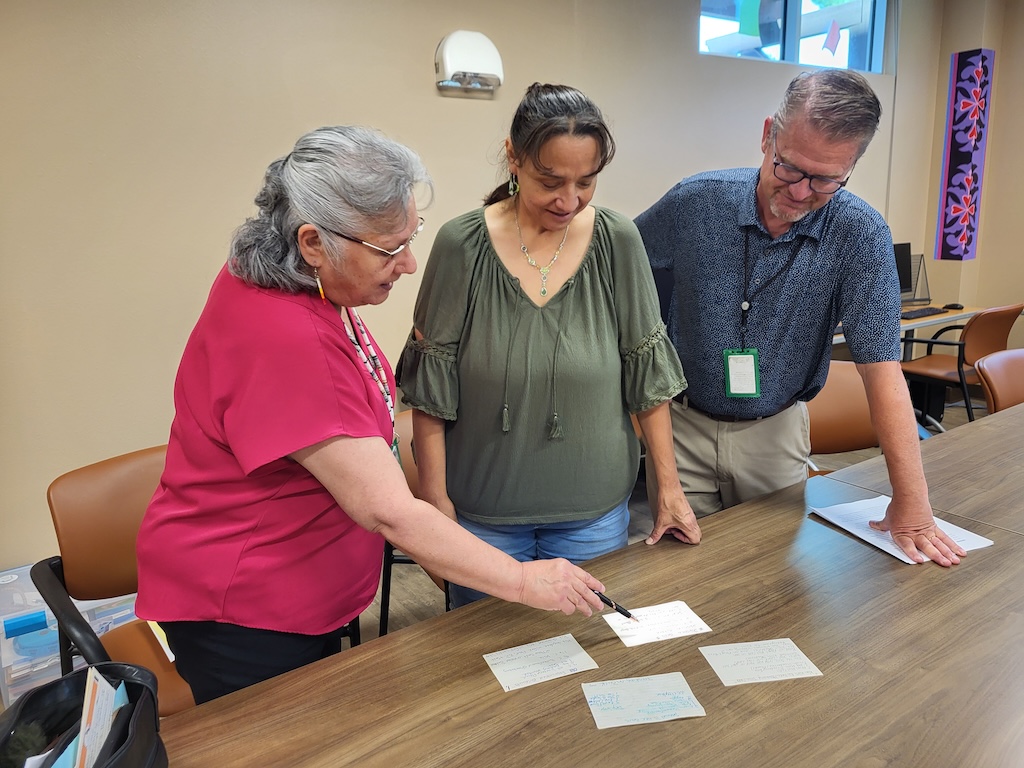
That is what a team from the College of the Menominee Nation is in the process of compiling. Working through a grant from the United States Department of Agriculture, Brian Kowalkowski, dean of continuing education, and Annette Tourtillott, job-based training specialist, are spearheading a project to collect recipes, and stories about the recipes, from members of the Menominee Indian Tribe of Wisconsin.
The two-year task is titled Menominee Mecem Community Cookbook Project. “Mecem” is the Menominee word for food.
“In the last 15 years or so, we’ve seen this resurgence of local food production, food sovereignty, food access, where the community is really entrusted in finding out about growing your own food,” said Kowalkowski. “We went through COVID and then we did see that there were issues with getting food into rural areas.”
Some of the motivation for the project came from how the opportunity to grow one’s own food leads into how to cook that food.
Tribal member Maggie Schlichting joined the project about five months ago. She is contributing recipes from her own collection, which includes some from her mother, Marlene Denny Sanapaw.
“I brought in recipes that my mom and I did together,” Schlichting said. “One is a recipe for old-fashioned biscuits.”
Tourtillott said that she knows there are many community members, like Schlichting, that have stories.
“It’s just a matter of getting them to feel comfortable enough to sit down and share,” she said. “I know that there are a lot of stories out there, and recipes. We just need to connect.”
Schlichting will help to bring in people, such as her friends and other contacts in the community, who are well-known for their tasty and creative recipes.
Tourtillott said that Schlichting is the first community member that they’ve met with.
“There have been about five others that have brought in recipes so far,” Tourtillott said. “I’ve just started compiling all of them now, typing them up.”
She said that compiling recipes as they come in is the stage where the project is now.
According to Kowalkowski, the two-year project is just ending its first year.
They are working to get information about the cookbook out to the community and getting people to contribute recipes and stories and memories about the recipes.
The project is looking for “people who are willing to come in and sit in an interview with someone,” Tourtillott said. Memories about traditional and family recipes passed down through the years will be the backbone of the cookbook.
In addition to submitting recipes and providing stories, contributors are invited to join demonstrations to teach younger members how to cook their recipes.
Tourtillott said that the college has a youth project coordinator, Tillie Peters, who brings youth in for the demonstrations.
The cooking demonstrations are planned to be held at the Shirley Daly Hall building on the campus and will be open to anyone who wants to attend.
“Every year we do a seed giveaway,” Kowalkowski said.
He said that they set up information at the giveaway about the cookbook project as a way to advertise that they are seeking recipes.
Kowalkowski also said that information about the community cookbook project is also available at the Kehtekaewak “They Eat Food” Farmers Market on campus every Friday through Oct. 1 from 10 a.m. to 2 p.m.
A large display about the cookbook project greets people coming in to the Community Technology Center on the college campus. Part of the display features photos and information about foraging herbs that are culturally significant to food preparation, a significant part of the tribe’s traditions.
An invitation to tribal elders, families and local cooks to share traditional recipes and memories, along with recipe submission forms, are available at the display.
“We don’t want to leave anybody out,” Kowalkowski said. “So, we want to make sure everybody has an opportunity to get their stories into the cookbook.”
Anyone participating in the project can submit recipes and stories in writing, by spoken word or through an interview.
“I do have some recipes that were submitted for rabbit, turkey, venison, muskrat, squirrel,” said Tourtillott.
She said that the recipes were given to the project by Doreen Reiter and were from her mother, Mabel Dickie. The recipes were in Dickie’s handwriting.
“We have great cooks in the community,” Tourtillott said. “My son, Dustin Tourtillott, is one.”
She said that her son hunts, fishes, gathers and cooks wild game in traditional ways.
Tourtillott said that her food memories of growing up on the Menominee Reservation include her mother baking bread, and their neighbor, Mary Fish, cooking.
“My dad would go deer hunting, fishing,” she said. “I remember him cleaning the deer. Whatever he brought home from hunting or fishing, that was his responsibility to clean and cook. Everything had to be cooked slowly, nothing quick about it.”
Tourtillott said that her father taught her son, Dustin, everything about the woods.
“My dad took a lot of kids under his wing to teach them about the reservation, some who didn’t have a father figure,” she said. “Now they are teaching their kids, going forward from generation to generation.”
The college has a sustainable agriculture program. With the tribe’s agriculture and food systems department and other community organizations working together, there is a concerted effort to help people eat healthier, learn how to grow their own food and to cook.
Publishing the cookbook will be an additional resource for the Menominee tribe’s focus on helping its members eat healthier, according to Kowalkowski.
For information, or to share recipes and stories, contact Tourtillott at atourtillott@menominee.edu or 715-799-6226, ext. 3097.
MAGGIE SCHLICHTING AND MARLENE DENNY SANAPAW’S OLD FASHIONED BISCUITS
4 cups all-purpose flour
5 tsp. baking powder
1 tsp. salt
2/3 cups butter-flavored shortening
1 1/2 cups milk
2 tbsp. soft or melted butter
Mix together with a fork the flour, baking powder and salt. Put in shortening, mix with fork until it is crumbly. Make a well in the middle of flour. Pout in all the milk. Mix all together. Dough will be sticky. Use a spoon also. Put dough on floured surface. Knead for a bit, then pat out or roll it out, about 2 inches thick. Cut out biscuits. Brush tops of biscuits with butter. Bake at 375 degrees for 12-15 minutes.


