
Just a few decades ago, deer hunters who wanted to create a tack-driving rifle needed some amateur gunsmithing skills to tweak their factory bolt-actions.
Free-floating a barrel involved sanding down the wooden forearm so the barrel wouldn’t touch the wood. (Sliding a dollar bill between the two is still an easy way to check if your rifle is free-floated.) The next step involved fiberglass-bedding the action (usually with a kit from Brownells or other gunsmithing supply companies). Just don’t forget to generously apply the release agent to the stock, or you’ll end up with a permanently bedded action.
Some even replaced their factory barrels with Shaw, Shilen, Krieger, Green River or other air-gauged, precision barrels. And heavy factory triggers were replaced with Timney and other adjustable versions.
Savage was the first company to offer a user-adjustable factory trigger, called the Accu-Trigger, in 2002.
This forced most rifle makers to follow suit, providing light and crisp 3- to 5-pound triggers that make accurate shots at both targets and game much easier.
Although the demand for a custom rifle still exists, those who don’t want to plunk down $2,000 or more for a minute-of-angle (1 inch groups at 100 yards or less) rifle no longer need to. Competition among the major rifle makers has created affordable firearms loaded with accuracy-driving features that used to cost extra.
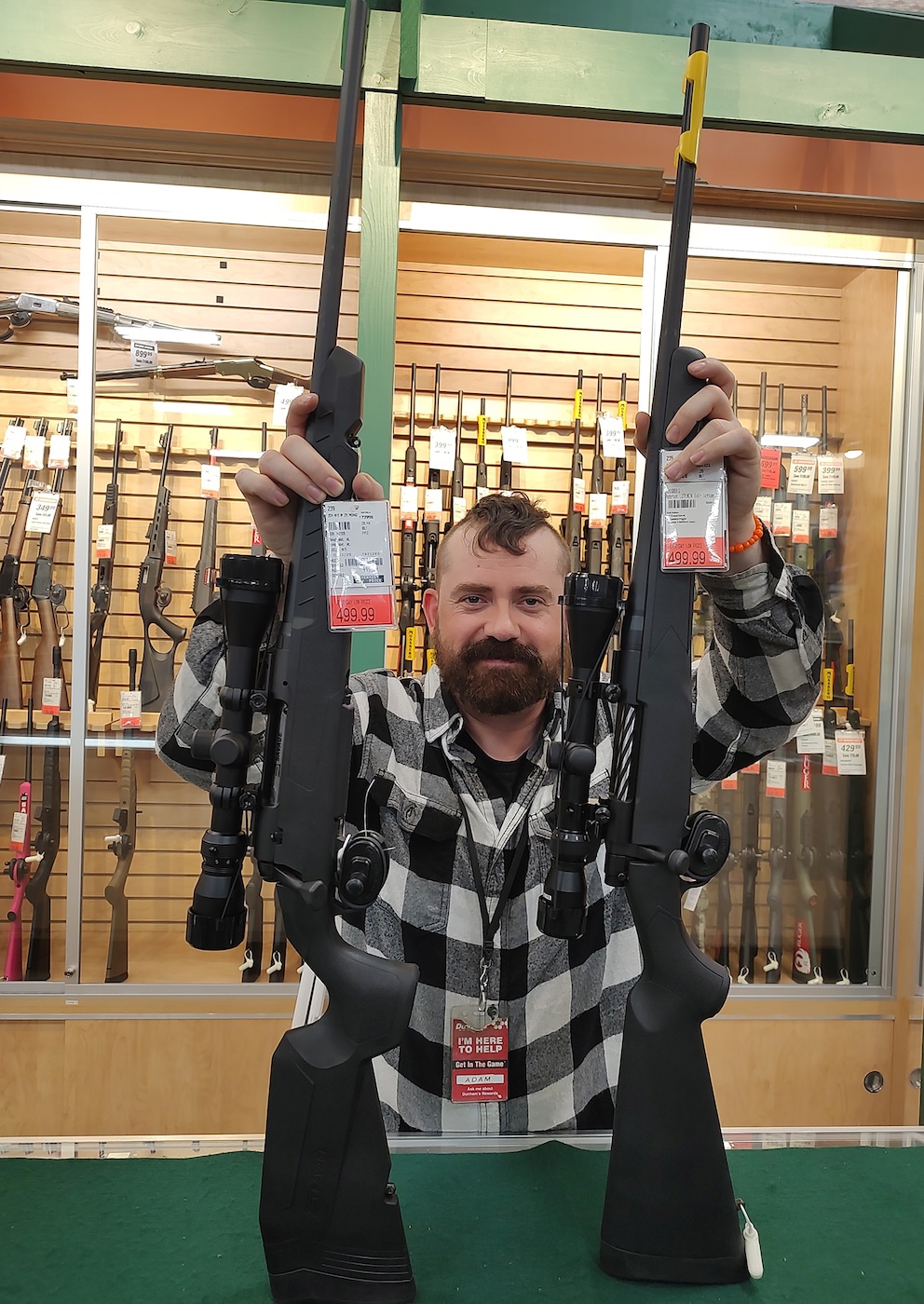
Savage, Mossberg, Winchester and a few other companies have even created packages with a rifle and basic scope for $400-$550. Although the scopes are on the low end, most are serviceable for hunting in good light at average distances out to 250 yards. Their accuracy is proven year after year in the field and in extensive tests by magazine authors.
Mossberg and Savage rifle combos are the hot sellers at Dunham’s Sports in Shawano, according to Adam Delzer, assistant store manager. While new deer cartridges like the 6.5 Creedmoor, 6.5 PRC and .28 Nosler are creating magazine buzz, Delzer’s customers favor the old classics, with the .308 Winchester and .30-06 Springfield his best sellers, followed closely by the .270 Winchester and .243 Winchester next in line. The .243 has low recoil (“kick”) and is a good choice for younger and smaller shooters.
“Most know what they want,” he said of his customers.
For a rundown on some of the newer deer cartridges, read www.themeateater.com/hunt/firearm-hunting/10-best-modern-hunting-cartridges.
But as the old saw goes: If it ain’t broke, don’t fix it. It is easier to find ammo for common rifle chamberings, especially if you run out in a remote area and need to find more in a small-town hardware store. That’s why it pays to buy your ammo early.
Ruger, Tikka, Bergara and others opt to sell just the standalone rifles and let the hunter choose his or her own optics as they wish. Hunters can find a decent scope in the $150-$200 range, but if you are on a once-in-a-lifetime guided hunt and are shooting at a trophy with just a few minutes of daylight left, the extra brightness of a high-quality scope will be money well spent. I’ve always had excellent luck with Leupold, the gold standard (with a gold ring around the objective lens to prove it) that’s made in USA.
Other good choices are Burris (also USA made), Bushnell (made in Japan, China and South Korea; the Elite series is worth the extra money) and Weaver (made in USA, Japan, the Philippines and China).
In general, the higher the price, the better the glass. Use a lower magnification (2 to 7 power) when hunting in thicker cover. You will seldom need more than 9 power, even in open country, because anything over 9 power is difficult to hold steady without a rest.
A 2-7 or 1.5-4.5 power scope is usually much brighter and offers a wider field of view for quick shots out to 100 yards, but a 3-9 scope is fine, too. Keep your scope set on its lowest power when waiting for a deer to appear.
Vortex Optics, based in Barneveld, is a popular brand and one of Dunham customers’ favorites, according to Delzer. Most of the lower-end Vortex scopes are made in China, with higher-priced models made in the Philippines, Japan and the United States. Here’s a guide to where various models are made: https://scopesfield.com/vortex-scopes-manufactured/.
Putting a $200 scope on a $600 Ruger American II will obviously exceed our $600 limit, but don’t be afraid to look at used rifles. Dunham’s and Fleet Farm do not sell used guns, but Cabela’s (the Green Bay store is now branded as Bass Pro Shops, parent company of Cabela’s) and Scheel’s carry used firearms.
Scheel’s offers a one-year warranty on used guns, while Cabela’s/Bass Pro offer a three-day warranty on mechanical defects.
Now that you’ve bought a rifle and scope (or red dot sight, which is generally faster on target but battery-dependent), here are a few accessories to complete your deer-hunting package:
• Sling. Every rifle needs a good sling, which makes it easier if you are carrying a tree stand, backpack and other gear. Get one that has a non-slip section so it doesn’t slide off your shoulder. Another trick is to sew a sturdy metal button on your shoulder to keep the sling from slipping.
• Stock-mounted ammo carrier. This is a handy way to carry a few spare rounds. Most are made of an elastic material that slides over the stock to face the side away from your cheek.
• Bore-sight tool. These make it easy to quickly rough-sight a scope. An easy way to sight in a bolt-action rifle initially is to remove the bolt and set the gun in a gun vise. Look through the bore and center the bore on the bullseye. Now adjust your scope to center the crosshairs on the bullseye. Make sure all your base screws and ring screws are tight (Loc-Tite is recommended) before making any adjustments, and then fire a few shots at the distance you plan on shooting. Most rifles are sighted in for a dead-on shot at 100 or 200 yards.
Dunham’s offers free scope mounting and boresighting for all customers, even if you didn’t buy your gear there, Delzer said.
Ross Bielema is a freelance writer from New London and owner of Wolf River Concealed Carry LLC. Contact him at Ross@wolfriverccw.com.


