Over our heads these days, mostly while we sleep, millions of birds are making their way south on their fall migration. Guided by the stars and other cues, they navigate great distances from their breeding grounds in the north to reach the warmer parts of North, Central and South America where they spend their winters.
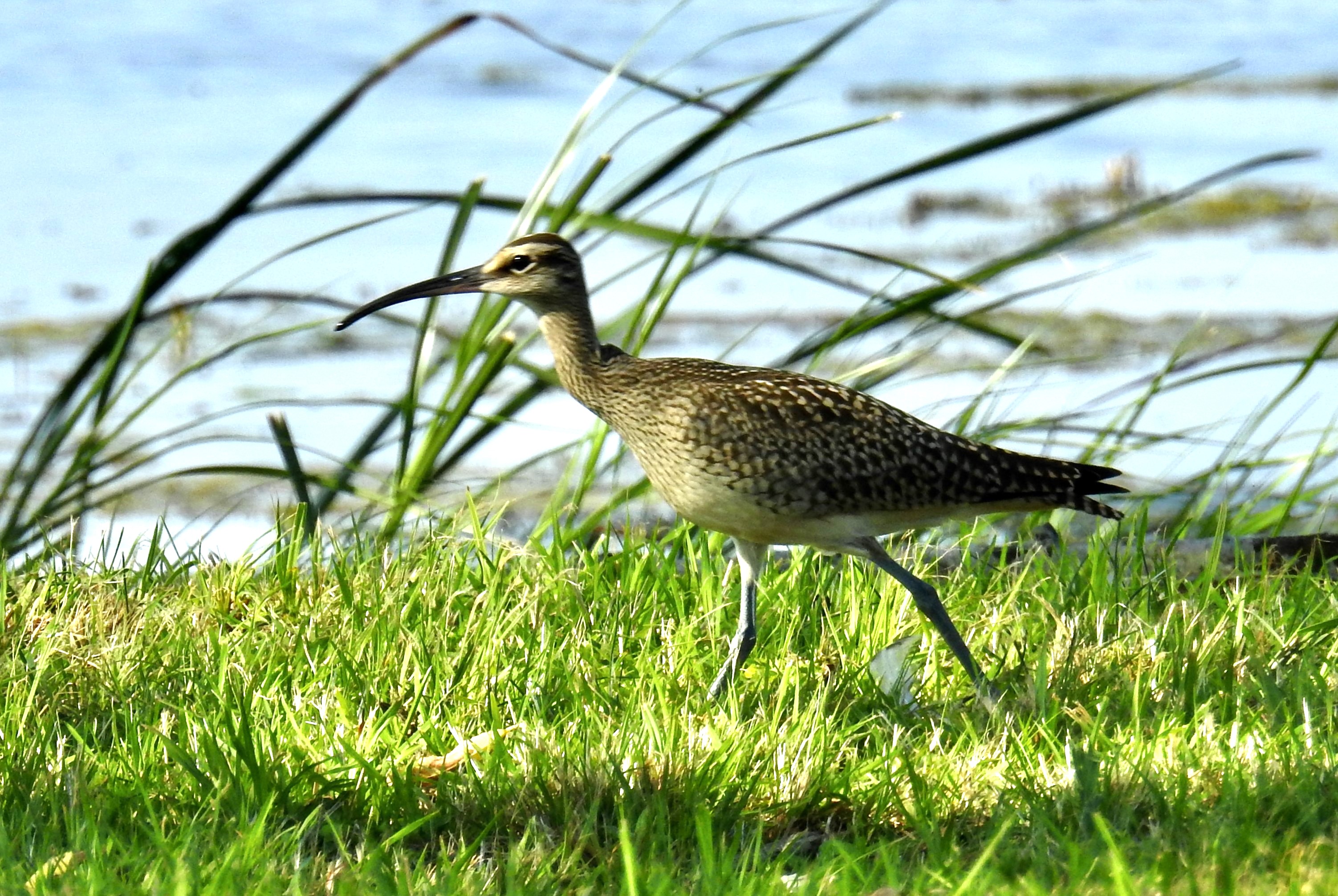
I was fortunate to see a pair of one of the long distance migrants, the whimbrel, at Red Arrow Park in Marinette earlier this month when scouting for birds with the Marinette birding group. The whimbrels were foraging along the shore. According the Cornell Lab All About Birds (AAB) website, their long down-curved bills provide the perfect tool for probing the nearshore areas for invertebrates, such as crayfish, small fish and snails in our part of the world and crabs, sea cucumbers, sand shrimp, and marine worms along the ocean coasts.
Other distinguishing features of the whimbrel are its large size (about crow size), mottled brown and white feathers along its back and neck, tan belly, head capped with brown and a distinct dark line running either side of the eyes. Its size and distinctive bill make it hard to miss.
Wanting to learn more about whimbrels, I found a shorebird story map (slide show) called “Whimbrels on the Wing,” on the Western Hemisphere Shorebird Reserve Network (WHSRN) website at www.whsrn.org/whimbrels-on-the-wing.
The conservation story of these birds is told with the help of three whimbrels fitted with transmitters that are revealing valuable information on the habitats they use and their amazing migratory journeys.
Whimbrels tracked by researchers have brought to light the amazing distances these birds traverse during migration. A male bird, called T6, flew 9,160 miles from its breeding grounds in northern Alaska to southern Chile. During one year, the same bird flew nearly 20,000 miles over the course of its migratory journeys.
Another whimbrel, named Postel, revealed the amazing stamina these birds have; they can fly for days without stopping. Postel flew 2,000 miles, non-stop, for five days on its way north from the coast of Georgia (a stopover site) to Ontario, Canada, where it rested one day, then flew two more days to reach his nesting ground near Hudson Bay. During its fall migration, after flying south to the Georgia coast once again to refuel, it flew another 3,400 miles non-stop to its wintering grounds on the coast of Brazil.
Tracking whimbrels has also shown that there are at least three separate migratory routes they take from the far north to the tropics. To help the birds on their long journeys, a series of important breeding, wintering and stopover habitat areas have been secured and are part of the WHSRN.
There are currently 119 WHSRN sites located in 20 countries covering almost 40 million acres. These sites have been championed by 443 partners who have diligently given their time and expertise to protect these areas for whimbrels and other shorebirds on the wing.
It’s hopeful to know that so many people are doing so much to protect these birds across the Americas. This is especially important considering the many threats shorebirds face along their migratory routes, including those pointed out on the AAB website; the loss or modification of coastal wetland habitats, environmental contamination, and rising sea-levels that threaten the bird’s wintering and stopover habitats in particular.
It’s exciting that a pair of whimbrels is using Red Arrow Park as a stopover site where they can rest and refuel. It’s likely that this pair may have traveled to South America within a week of that stop.
You may not be lucky enough to see whimbrels this fall, but other birds are making their way south as well. Among them are thousands of warblers, raptors, sandhill cranes, Canada geese, ducks, egrets, pelicans and those rolling waves of blackbirds. Keep your eyes and ears open to catch some of this spectacle as fall unfolds and the skies become highways to the south for so many of our birds.
Cathy Carnes is a retired biologist in Oconto who worked with the U.S. Fish and Wildlife Service Green Bay Field Office and prior to that with the U.S. Army Corps of Engineers Regulatory Branch in Buffalo, New York. As endangered species coordinator for the USFWS, she helped conserve and recover federally listed threatened and endangered species in Wisconsin.
Fall migration brings whimbrels this way