
Some bucket-list items involve distant destinations or once-in-a-lifetime adventures. Mine were much simpler: see a baby loon and photograph one.
You’d think that would have happened long ago. I grew up exploring Wisconsin’s lakes and have spent the past 15 years at a Northwoods cabin where loons return each spring. Yet year after year, I heard their haunting calls without ever seeing a chick.
One misty morning changed everything. While quietly kayaking through a bed of water lilies, tucked in among the vegetation, I spotted a female loon sitting calmly on her nest, stretching her neck to gather nearby stems to reinforce it. As she leaned forward, I caught a glimpse of two olive-green eggs dotted with dark brown spots.
I stopped paddling. For several minutes, I simply watched. The lake was still except for the gentle sound of water against my kayak. I felt an overwhelming sense of joy and gratitude. Not wanting to disturb her, I quietly took a few photographs before slipping away.
For the rest of the weekend, I couldn’t stop thinking about that nest. Every few hours I returned, always keeping my distance. Research suggests loons can recognize individual people, so I hoped that by moving slowly, staying quiet and never lingering too long, she’d come to see me as just another harmless part of the landscape. She never seemed to mind having her picture taken — certainly less than many of my human friends.
When I returned the following weekend, my excitement turned to heartbreak. The nest was empty. The mother was gone. Later I learned a predator had taken the eggs. Nature can be breathtakingly beautiful and brutally unforgiving.
A few summers later, rumors spread around the lake that the resident loons had successfully hatched a chick. I drove to the cabin as quickly as I could. Within minutes of launching my kayak, I found them. There they were — mom, dad and a tiny ball of charcoal-gray fluff floating between them.
Almost instinctively, I lifted my camera and captured my first photograph of a baby loon. My bucket list was complete, but the accomplishment barely crossed my mind. I was captivated by the tiny life before me.
Throughout the summer, each weekend brought new changes. I watched the chick become more confident, more curious and more independent. Every sighting felt like a gift. By autumn, the chick had grown nearly as large as his parents. His fluffy down gave way to sleek juvenile feathers.
Once the parents departed on their annual migration south, I knew it wouldn’t be long before he left as well. Because young loons don’t usually return to their northern breeding grounds for several years, I knew our time together was coming to an end. I wished him a safe journey. Maybe, someday, he would return to these waters.
This summer brought another emotional chapter. The resident loon pair hatched two chicks, but before I could see them, one fell prey to an eagle. The loss was a reminder of how fragile life is in the wild. Week after week, as soon as I arrived at the cabin, I searched the lake for the surviving chick, relieved each time I found him still swimming beside his parents.
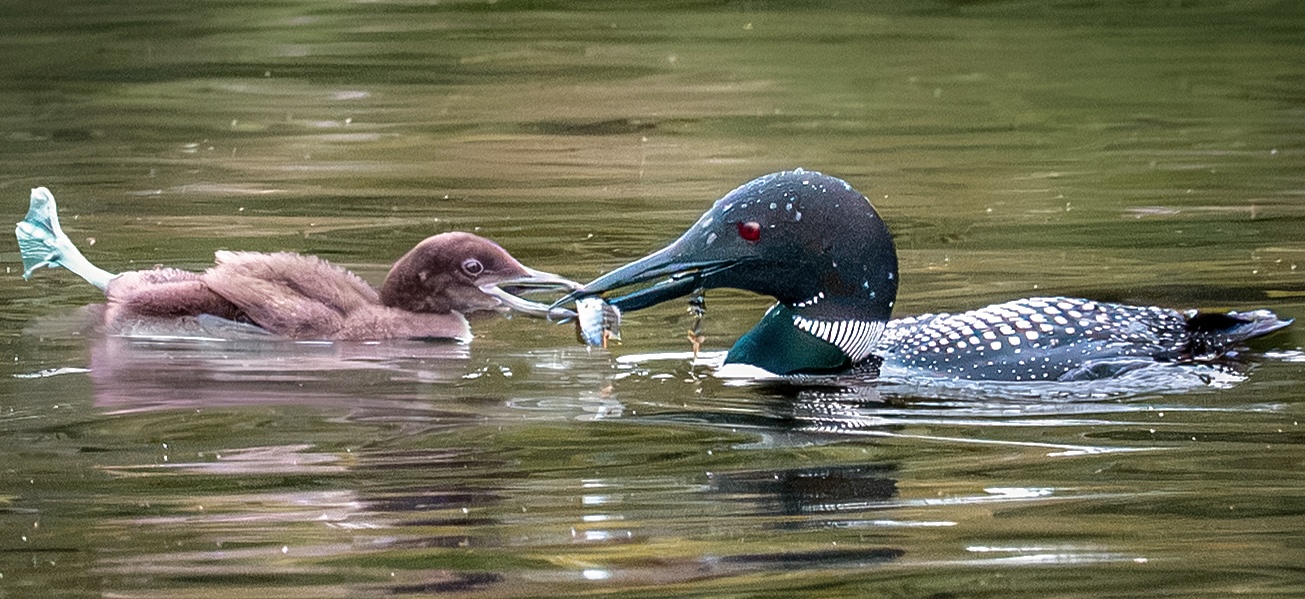
Loons are devoted parents. I often watched them scan constantly for danger, pulling their chick beneath a protective wing whenever they sensed a threat. They patiently delivered tiny fish, one after another, until he was ready to learn on his own. At first, the baby simply peered beneath the surface, watching the adults, but before long, he was catching fish himself.
Like any youngster, the chick provided plenty of entertainment. On one occasion, he surfaced much farther away than his mother expected, sending her racing across the lake faster than I thought possible. Other times, he popped up directly beside his father, who seemed mildly irritated by the surprise.
Today, the surviving chick is in an awkward adolescent stage, with patches of fluffy down still clinging to his neck while sleek juvenile feathers cover the rest of his body. Before long, he, too, will begin his journey to wintering grounds along the Gulf or Atlantic coasts.
Watching these loons has reminded me that nature offers no guarantees. Every successful nest, every surviving chick and every migration completed is something of a miracle. Those two empty boxes on my bucket list have finally been checked.
Looking back, the photograph was never the real prize. The true reward was being welcomed, however briefly, into the lives of one loon family. Watching a tiny chick grow into a young bird ready to begin his own journey has become one of the greatest wildlife experiences of my life and a reminder that some of nature’s greatest gifts are worth waiting for.
Lisa Jansen is a Wisconsin master naturalist, nature writer and award-winning photographer. She specializes in raising awareness of birds and butterflies of the Midwest.


