
It’s a tall task to recruit a new hunter to the turkey woods and kill one on the day planned.
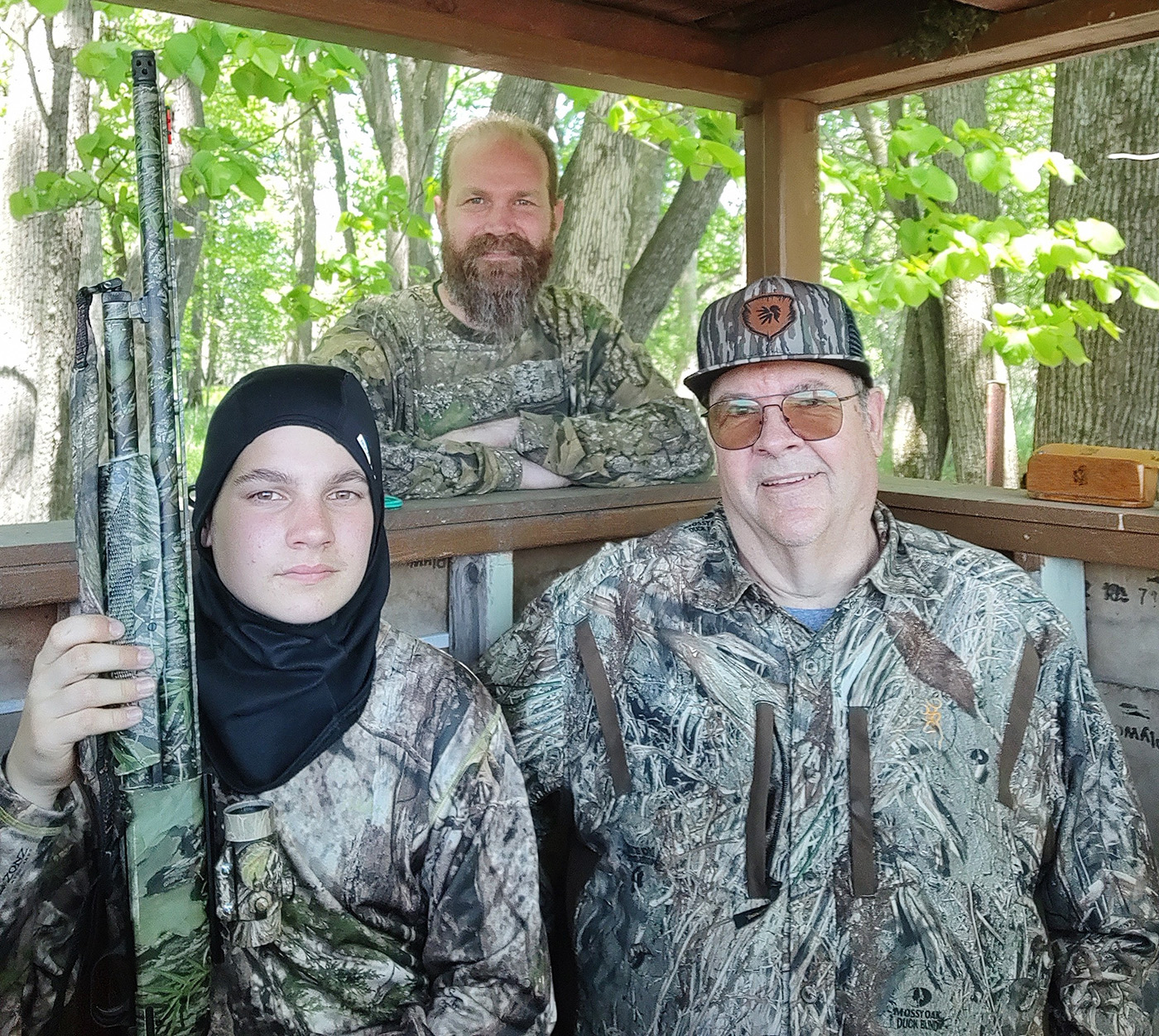
My experience with most teenagers is that they are fidgety and have TikTok attention spans. Roland Johnson, 13, of Juneau, was quiet, still and focused for about five hours in my spacious portable blind that we shared with his dad, Jeremy Johnson, on the morning of May 24. He was equally focused and anxious for a crack at a gobbler as he sat for three more hours in a permanent deer blind on the same property in rural New London that afternoon.
In between, we took a quick lunch of burgers and corned beef hash at a family café with a sassy waitress who kept making jokes about our camouflage.
We’d arranged the mentor hunt through Pass it On-Outdoor Mentors, an organization that has been spreading rapidly since 2002 from its home state in Kansas and has a goal of being in 40 states by 2030.
The group came to Wisconsin in 2024 with the hiring of Menominee Falls native Quinn Erdmann as mentor coordinator here. The organization contracts with the Wisconsin Department of Natural Resources to arrange about 120 mentoring events each year, including hunting of other game and even fishing, Erdmann said.
It is no secret that hunting is on the endangered list, with fewer young people picking up the torch. Kids are stretched thin with sports, video games, social media, hobbies and a dozen other things.
Outdoor Mentors requires all hunting participants to be hunter education grads (they also offer a variety of fishing opportunities), and Roland showed he’d listen well at an in-person class by handling his Mossberg 20-gauge pump shotgun safely throughout the day.
Jeremy said he definitely considered our hunt to be a learning experience for both of them.
I showed them my favorite box call, a handmade Ol’ Hess made decades ago by Gary Hesselberg in Davenport, Iowa, when I was a full-time outdoors writer for the Quad-City Times. I explained how a box call needs chalk on the striker and edge of the box to produce a sweet, delicate cluck. I carry a piece of chalk at all times inside the call. I let Roland try it a few times and he made it talk, too.
I also carry an array of slate calls, which are just about as easy to use with a little practice. Sometimes the slate or glass surface needs to be scuffed up a bit with a piece of sandpaper, but because we had birds around us off and on all morning, I didn’t spend much time with the slates.
I explained an owl hooter, which is used as a locator call. When toms are in the mood, any loud noise (barred owl hoot, crow caw, thunder clasp or even the slam of a car door) can get a gobbler to gobble. The birds weren’t calling much, which is not unusual. They seem to gobble the most early in the morning, sometimes even from their roosts.
I had planned to demonstrate diaphragm calls, too. One of the turkey hunter’s greatest tools is the turkey hunting vest, a lightweight vest with multiple, vast pockets to hold pounds of calls, strikers, shells, face nets, camo gloves, pocket knives, paracord, snacks and water bottles.
I searched all my vest pockets for a black squeeze pouch of diaphragm mouth calls and never found it.
The biggest mistake rookie diaphragm callers make is trying to blow through their lips while holding the C-shaped latex call between the back of their tongue and the roof of their mouth.
The closest we came to a gobbler was about 7:45 a.m. The bird came from the north side of an open cornfield and seemed to be coming to my call and decoys. At about 100 yards, the tom angled away toward the farmhouse and then walked across the road.
“I acted like a deer was coming,” he said.
Both he and his father shot their first deer last season, and now they have another game animal to pursue together.
The afternoon hunt ended in a deer blind overlooking a different part of the cornfield.
About 3 p.m., Roland said, “There’s a fawn.”
It was about 50 feet from the blind in tall grass, and hard to see. The mother soon appeared, snorted at us and tried to get us to give chase. I didn’t want to tell Roland we probably wouldn’t see any more turkeys till close to dark, but he made the decision to leave, because he wanted the fawn and doe to reunite.
I invited them both to come back next year and give it another try.
Ross Bielema is a freelance writer from New London and owner of Wolf River Concealed Carry LLC. Readers can contact him at Ross@wolfriverccw.com.


