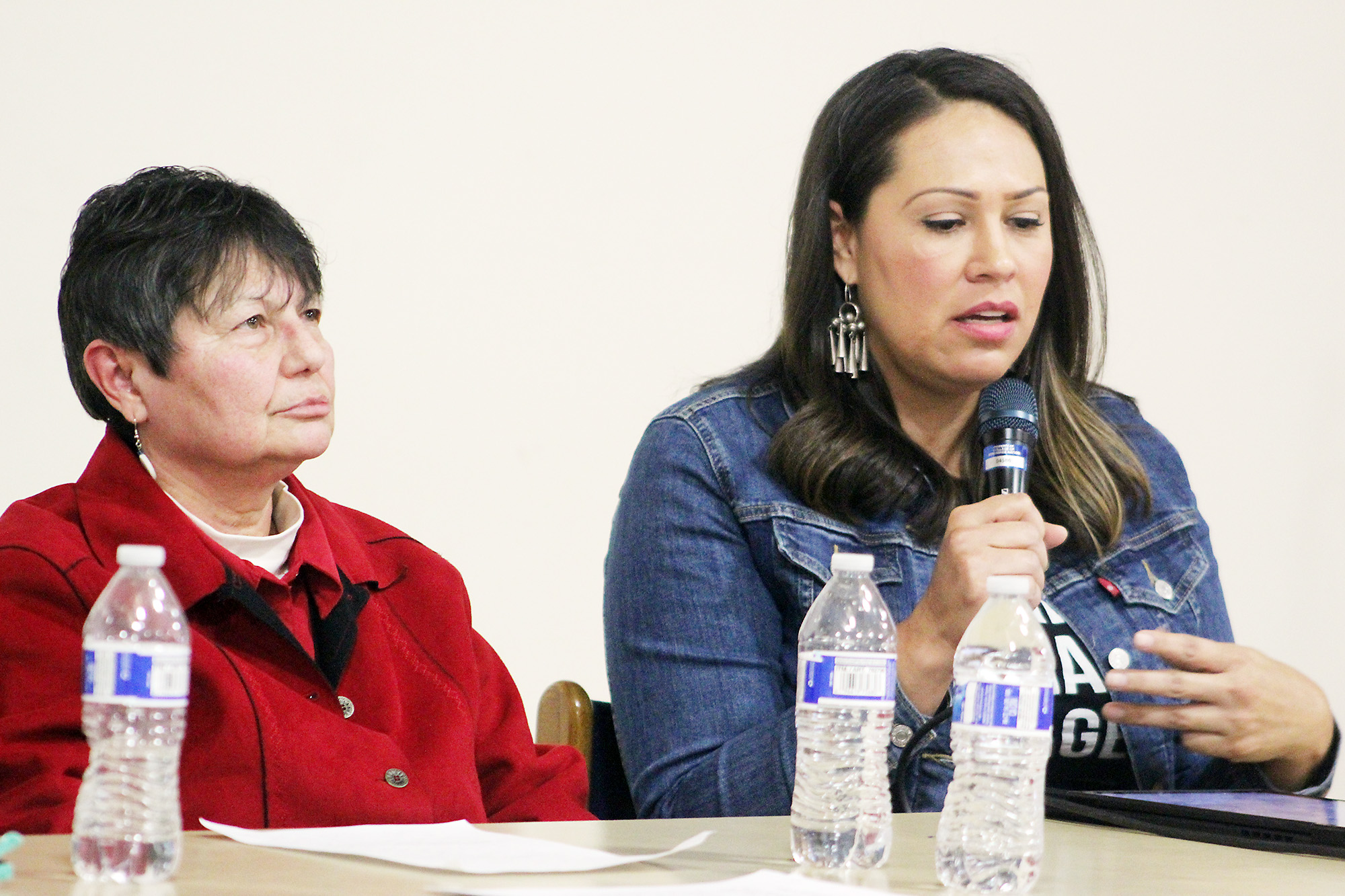
KESHENA — Reversing the trend of missing and murdered indigenous women will require a fundamental shift by tribes back to traditional ways, experts said in a panel discussion held Thursday at the College of Menominee Nation.
Menikanaehkem, a Menominee-based organization, hosted the two-hour forum that examined issues that contribute to indigenous women being victimized and the crimes left unsolved. They also looked at grassroots organizing by tribes to get the issue off of state and federal back burners and how indigenous rematriation — allowing women to be on the same level socially with men — helps deter gender-based violence and for the victims of that violence to heal.
It is difficult for advocates to pinpoint the number of missing and murdered indigenous women, but it is estimated there are thousands in the United States alone. Federal statistics do not break down such cases by race and the same is true for many states, including Wisconsin.
One thing that most on the panel agreed on was that the woes experienced by Native American women both on and off the reservations dates back to European colonization.
Lori Lemieux, a member of the Bad River Tribe, said that centuries of being seen by “settlers,” the colloquial term for white people who expanded the boundaries of America, as inferior have fostered a mistrust in the criminal justice system. Many tribal people who are victimized are afraid to speak up for fear of retaliation.
Lemieux saw that mistrust first hand when she experienced a sexual assault in the 1990s. She reported what happened, but she has never seen justice.
“I was wanting to be heard,” Lemieux said. “I had no faith in law enforcement. That is a big fear that remains still.”
Maria Haskins, a member of the Lac Courte Oreilles Band of Ojibwe, has worked with the criminal justice system and child protective services. She said she has seen many young boys and girls who have had to leave the reservations for various reasons. Many of the them experience trauma from those experiences, and some run away from home and fall prey to substance abuse, human trafficking and other issues.
“When you have the exposure to all of these elements, you’re placing yourself and the community at risk,” Haskins said.
Mary Webster, a Menominee who sits on Menikanaehkem’s women’s leadership cohort, noted that many tribes have lost their way mainly due to historic attempts to “Americanize” Native Americans through the boarding schools, where children were separated from their families and forced to abandon their language, culture and values.
Webster has 17 grandchildren, 13 of them girls, and has had a discussion with them about being cautious when out in public because Native Americans are targeted more often for crimes.
“As a community, we need to have things in place so that our people aren’t put back where they’re used to,” Webster said. “The big thing is having culture and tradition, and that starts with the teachers — parents.”
Marisa Cummings, a member of the Buffalo Tail Clan of the Sky, said that with most Native American women, it’s not a matter of if they’ve experienced sexual violence but how many times. She said it’s important to talk about the offenders in the community, especially if they are in leadership roles, and how to rehabilitate them.
“How, as women, do we organize in a way that is a culturally-based way and a healing-based way of addressing those perpetrators,” Cummings said. “We don’t want to throw anyone away … and we want them to heal and be productive and kind.”
Reestablishing matriarchal societies with tribes resonated with the tribes and was seen as a way to give women a voice in a society where men are in the majority in leadership.
“Matriarchy is women, ourselves, holding that duty to take care of one another and our children,” Haskins said, adding that it is important to teach indigenous values to others.
Lemieux noted that the matriarchs need to make sure children know who they are and where they come from. She sees many girls and young women who don’t have that structure.
“We are the backbone,” Lemieux said. “We are the lifegivers.”
Cummings said that matriarchy, in this day and age, requires relearning how to be a woman. In traditional tribes, women historically held a fair amount of power, but it was equal to what men held.
“It’s all about this balance — women carry the water, and men tend to the fire,” Cummings said. “We had a way of doing things where it wasn’t one being over the other.”
Kristin Welch, a Menominee tribal member who moderated the forum, pointed out that the women’s issue is more than a Menominee issue or a Wisconsin issue, and the only way action could be taken is if people everywhere organize to force the issue from a place of silence.
“This issue isn’t just in one place, so we can’t just organize in one place,” Welch said. “It’s important to have all of those voices represented. This is global.”
She added that state Assembly and Senate bills to form a task force to tackle the issue of missing and murdered indigenous women are still sitting in committees and have received no public hearing.
It was important, above all, not to give up the fight for the indigenous women who have never come home, especially if they are still alive somewhere, Lemieux said.
“I think about those women every day,” she said. “Some of this fight is not just about empowering us as much as it is holding those responsible for investigating these missing people and making sure the work continues.”
lpulaski@newmedia-wi.com
Traditional ways seen as deterrent to victimization