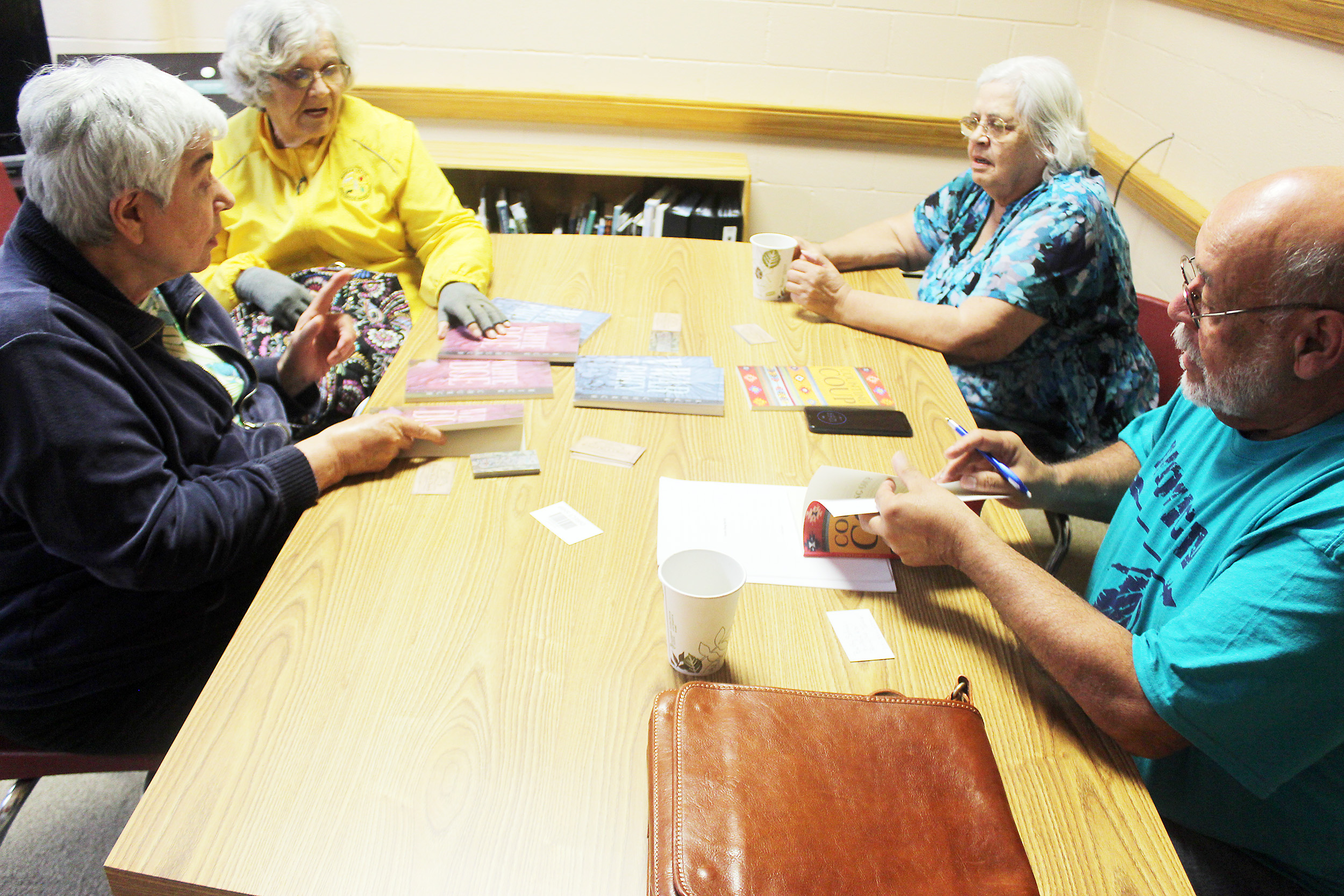
BOWLER — Rick Church, an enrolled member of the Stockbridge-Munsee Band of Mohican Indians, spent much of his life in law enforcement, keeping the streets safe from anyone from simple burglars to sex traffickers and smugglers.
Today, Church is happily retired from that life. But Noel Two Horses, his alter ego and protagonist in his books, is not as able to walk away from combating evil and saving the innocent. Two Horses has saved the day in three books so far, and Church brought all of them Friday to his original home on the Stockbridge-Munsee Reservation as he presented them to a small audience at the Arvid E. Miller Library Museum.
Church has a group of retired police officers in his second and third books, all Native American and living in Tucson, Arizona. Some of them are former Border Patrol agents, city police, county deputies and federal agents from the southern part of Arizona, which borders Mexico.
“What led me to write this one was that a friend of mine, who was a Tucson police officer, wanted me to go to a monthly meeting,” Church said. “I didn’t like to go to meetings, but I said, ‘Sure.’ He said it was a bunch of retired cops, so I figured I’d know some of them.”
When Church went to that first meeting, he said he was amazed just how many of them he knew. He started talking with them and was floored by how many stories there were about certain cases.
Church certainly brought a lot of his own stories, having worked as an Arizona State Trooper, a federal marshal and an agent for the U.S. Drug Enforcement Administration and the U.S. Department of Justice. Prior to moving to Arizona, Church was a familiar face in Shawano County, working for the sheriff’s department and the tribal police.
“I got sent out on some pretty weird assignments when I was a police officer,” Church said. “I was working as a fraud supervisor in the state of Arizona, and I covered from Phoenix all the way down to the border. When you work fraud cases, you picture ledgers and embezzlement. I was getting involved in cases where older Mexican guys were selling used caskets.”
Church said those guys even offered him his own casket to keep quiet.
“I told them, ‘I don’t think so,’” Church said with a laugh. “I decided to write some of these down, as weird as they sound. They almost sound like fiction.”
Church noted there were times he would need to go undercover as a drug distributor when he was with the Department of Justice. He would deal with sellers from Cuba and South America, as well as the garden-variety Mexican dealers, and he did it without knowing how to speak Spanish.
“I knew my way around the drug culture, so they didn’t care that I didn’t know how to speak Spanish,” Church said. “Generally, you wouldn’t do a high-level drug deal without somebody talking for you, anyway. You would just supervise and say ‘yes’ or ‘no’ — and it worked. My wife wasn’t too crazy about it.”
In his second book, “War Party,” Church writes about how many of the fictional retired officers are banding together to avenge the death of an immigrant and look for a girl who disappeared while crossing the border.
“It’s a sad one because it explains some things that are really happening down on the border right now with families being separated,” Church said, noting that he dealt with some kidnapping cases when he worked in Arizona.
All three of Church’s current books, including his first one, “White Doe,” and his latest story, “Counting Coup,” are going to be put into a single anthology. The books are published through Page Publishing.
Thomas Cobb, author of the book “Crazy Heart,” which became an Academy Award-winning film, reviewed “White Doe” and said, “Rick Church has written a wise and witty thriller, full of breathless encounters and dark, dry humor. It’s a fine read.”
“The people I know always want to know, when is my movie coming out?” Church said.
Church has a fourth book due out soon, titled “Drums Along the Fox,” which takes place in Wisconsin. The book will be published directly through Amazon’s Kindle Publishing, starting out as an e-book and then coming out in paperback.
“That book details a lot of the drug issues we have on our reservations today — not just on this reservation but, as a rule, the majority of reservations in Wisconsin,” Church said. “The Fox River is a main inlet area for distribution.”
Church said the issue of drug trafficking is particularly prominent today. He said a lot of the young people living on a reservation went to school off the reservation and don’t find much entertainment at the casinos, so much of their “entertainment” is recreational drugs.
“There’s quite a market for it on reservations from one reservation to another reservation,” Church said. “It’s a closed-knit channeling way of life, and it’s generational. You talk to some of these young people in drug treatment, probably because their parents never went to drug treatment or were alcoholics, and their main source of entertainment was on a bar stool. It’s really sad, but there’s an unbelievable amount of money to be made.”
Books on the border