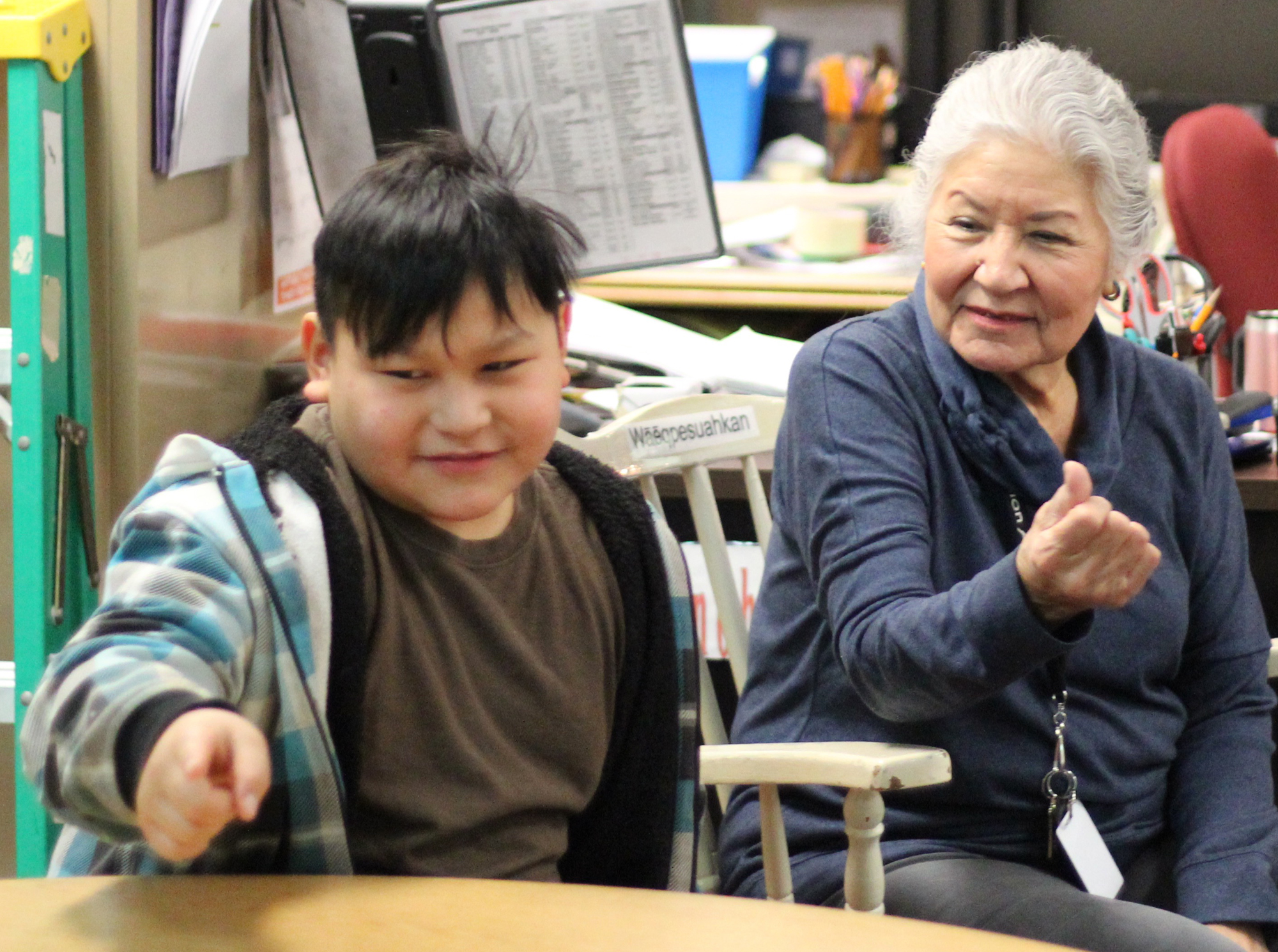
KESHENA - Elders for the Menominee tribe are more than a group of people advanced in years. They’re a critical source of cultural continuity and growth.
After chatting for a while on the meaning of being a tribal elder, Margaret Snow grew very quiet. “When I stopped to think about it, it brought back so many memories.”
“We want to pass on as much as we can, what we’ve learned. It’s so very important because the children have to have the knowledge as it was passed down to us on how to walk the good, red road, the Native American way,” Snow said.
The 76-year-old enjoys being a grandmother and great-grandmother and likes to remember her parents and grandparents. She wants to be part of making connections between generations but she stopped short of saying an elder has a duty to be a transmitter of culture and language.
“I just feel as an elder, and I tell my students this, that you need to talk to your elders and ask them about the stories and the traditions,” she said of her 10 classes of third, fourth and fifth graders at Keshena Elementary School.
“I try to pass this on to my students. Some of them don’t have grandparents so I try to be a ‘gramma’ to them. There are things that I know and I do what I can to pass them along.” She got quiet again and added, “It’s a really good feeling to do that.”
“When you’re an elder, you’re always learning. There’s so much to learn about Menominee,” she said. She goes to the tribe’s language and culture center on Wednesdays to engage with other elders and learn more about the language.
After thinking about the conversation overnight, she said, “I know I’ve been here for a long time. There was a lot I had to learn when I was young. Even in my own older years, I continue to learn. The elders I learned from, they’re all gone now. But they told me, ‘Now you have to go into the schools and teach what you’ve learned.’ The students ran me at first but I stuck with it.”
Even when her husband suggested she could quit, “I never thought of quitting. I took up courses on classroom management and here I am today. You have to be the teacher and know how to be strong.”
She added, “I want to say my parents and grandparents are built right in me. They knew a lot. But there were many, many other good people who nurtured me. People were good to me and guided me. The elders and many people from all walks of life, they’ve paved a path I chose to follow. I have so many people to thank. If I can do the same for these students, that is so worthwhile,” she said.
Joey Awonohopay, director of the tribe’s Department of Menominee Language and Culture, said a person can be an elder without being fluent in the language. And it doesn’t require isolation from mainstream American culture as an elder “can live in two worlds,” he added.
But there’s a distinct difference between a person advanced in years and an elder, Awonohopay said. “Someone who is elderly is not necessarily an elder.”
The Menominee language makes this distinction with one word for elder and another word for an old person.
If there is an age threshold, it’s 55, Snow said but added, “Some of the elders are very fussy about the age.”
“It’s not something automatically conferred. It’s a very, very honorable way for someone to describe you,” Awonopohay said.
“For me to call someone an elder, it means they have lived a certain way, that they have acquired all of this knowledge. That pool of distinguished, honorable people is very small,” the director observed.
“When I was a child in Zoar, we were raised in a certain way, very protected, tradition-wise,” Awonopohay said.
He grew up thinking all of the reservation communities were the same, calling it a “huge culture shock” even going the few miles to school in Neopit and Keshena and finding out traditions and language were not being passed on.
One of Snow’s proudest achievements is the establishment of a drumming, dancing and singing program in her classroom as another way to help children walk the good, red road.
Drawing on her experience and enjoyment of being a traditional dancer for many years on the powwow trail, “I first went to the elders to get their approval because I wasn’t an elder then.” Snow herself still dances but only at the annual warriors’ powwow.
There was a condition set down by one elder, Snow recalled. When the boys aren’t drumming, she was told, they have to dance.
Snow has followed that condition and boys now dance, either fancy or traditional or crow hop styles, when they aren’t seated at the drum.
She said she knew as a woman she wouldn’t have a place at the drum but told the elders she knew how to pick a drumming instructor. Girls do have a place in the program as “canary singers,” she said.
Looking at the years that have passed, she’s found, “It’s great, it’s wonderful” to have one of her students come back and teach drumming.
As she prepared the daily smudging of her classroom using sage, cedar, red willow, sweetgrass and tobacco, she paused to laugh and say, “That’s one of the good things about being an elder. People bring you stuff.” She said she isn’t able to gather red willow from or river bottoms any more but people bring it to her. “Someone always makes sure I have sage,” she added
Awonopohay noted that being aware of cultural norms makes him a better teacher. He said there is an emphasis on “moving, observing, hands-on” aspects of learning for Menominee children instead of sitting still, listening and taking notes while a teacher lectures. “That’s how we learned, how elders passed on knowledge.”
Snow agreed and her classroom activities reflect that physical approach with children moving around and pointing at objects, words or pictures.
Awonopohay said much of the desire to protect the language and traditions comes from the boarding school generation where children were removed, sometimes forcibly, to schools away from their families where traditional language, culture and even hairstyles were banned. He remembers that when the Menominee Indian School District started in 1976 with an emphasis on preserving and teaching the language, his grandparents were very happy.
“It’s part of our identity as Menominee. Once our language is lost, totally lost, we are just hollow shells residing on Grandmother Earth,” he said.
For example, if a Menominee child says in English, “play me outside,” parents may be quick to correct them because it’s not proper English but it does reflect the structure of the Menominee language, Awonopohay said.
Discovering the language structure, vocabulary and meaning is “like looking at the stars, all of those bits and pieces. Just like when all of those stars start to align, I understand ‘That’s why we do it this way, that’s why we say it this way,’” Awonopohay said.
Transmission of language and culture is not all one-way from an elder to a child, Awonopohay maintained. There is reciprocity in children evolving expressions from their original emergence in Menominee to current usage.
Snow said she hadn’t seen that in her classes but added she teaches primary grades and maybe they don’t know enough of the language yet.
“That’s our hope,” Awonopohay said, crossing his fingers that the immersion and language programs will mean the tribal legislature will sound very different 20 years from now.
There are demonstrable benefits to re-instilling language and culture, Awonopohay continued. He cited a Canadian study where indigenous people with a strong base in language, tradition, spirituality and cultural activities had lower rates of diabetes than those without that grounding. “That made sense to us and made us look hard at our cultural practices.”
It’s a “shift from unhealthiness, ‘I can grow this in my garden, I can harvest this from the forest, this meat is healthier than that meat,’” he said.
Those attitudes and beliefs are reflected among some younger tribal members.
Kristin Waukau, tribal dementia care specialist, takes her job very personally as she was a primary caregiver for her grandmother who had Parkinson’s disease with dementia. “If had known then what I know now, we would have had a better relationship.”
Part of her commitment comes from, “We cherish and honor our elders. That’s where a lot of our teachings come from. I try to teach my own daughters to respect them. All of our elders are our grandmothers.”
“That’s something my father and my grandmother taught me,” Waukau said.
Margaret Snow reflects on elder's role