Most bowhunters have a dozen things to do before deer season, but choosing which bow to use isn’t one of them. Of course, I have to be different.
I have always loved vintage recurve bows as well as longbows, and if you are a regular reader, you know my goal is to drop a deer with one of these wood-and-fiberglass classics. I have a modest collection of Bear, Wing, Ben Pearson and other traditional bows, as well as one modern takedown recurve.
On a recent trip to my in-laws’ lakefront cabin on Lily Lake near Pickerel, I brought three recurves along for a little testing. This is the latest I’ve begun the bowhunting season, probably because the unseasonably warm temperatures require quick animal recovery to avoid tainted meat, and because the summer insects are still plentiful. I also prefer hunting in crisp fall air, not T-shirt weather.
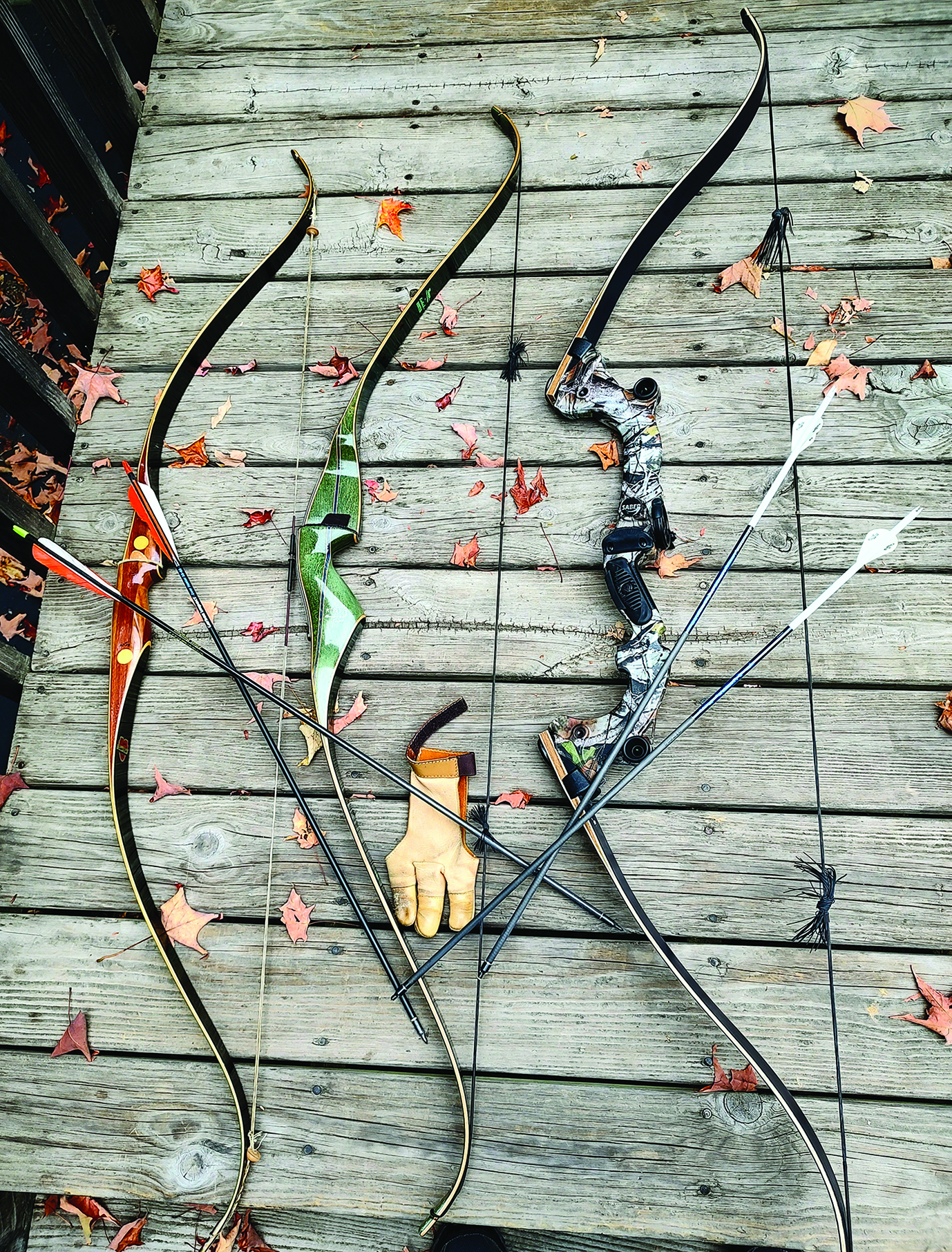
The three bows tested were a 50-pound Bear Kodiak Hunter, a beautiful green classic dating to about 1973; an Eddings Super Cast Spartan recurve, also green (manufacture date unknown); and a more modern 40-pound Martin Sabre recurve takedown with an aluminum riser (handle) and fiberglass limbs.
The only wood on the Martin is in the laminated fiberglass limbs, which makes it less beautiful than the other two. Here is a more detailed review of this bow online: www.bestrecurvebowguide.com/martin-saber-review-recurve-bow-inspection.
Martin went out of business many years ago, and Damon Howatt bought out their traditional bow manufacturing.
I brought an assortment of aluminum and carbon arrows, most fletched with feathers as required when shooting a recurve bow off the riser shelf (as the Bear and Eddings are set up), but I also brought a few of my vane-fletched carbon arrows from my compound bow days.
The Martin is fitted with a Whisker Biscuit, a unique arrow rest that is simple and holds the arrow in any position for shots at awkward angles. It’s the first Whisker Biscuit I ever shot, and I love it. They are still used on modern compound bows, although drop-away arrow rests now dominate the market. I’ve never been a fan of any mechanical gadgets that can fail in the field, as they are apt to do, so never used a drop-away rest and probably never will.
There has been more written about Bear Archery Co. and its founder, Fred Bear, than probably any other traditional bows in history. Fred Bear killed almost every big game animal, from tigers and polar bears to elephants, and you could see some of them at the Fred Bear Museum in Gainesville, Florida, as my wife and I did to celebrate our first anniversary back in 1999 (she says she would never go back – funny how they change, right?) The museum closed in 2003, and the items were sold to Bass Pro Shops. Their flagship store in Springfield, Missouri, now displays some of his bow kills.
I use Jorge L. Coppen’s book “Bear Archery Traditional Bows: A Chronological History, 1949-2015,” to date my Bear bows. It is well illustrated and will get you within a year or two of manufacture on most models. Here’s a link to the book: www.barnesandnoble.com/w/bear-archery-traditional-bows-jorge-l-coppen/11....
My wife, Michelle, assisted me in my unscientific bow testing. She stood facing away from me as I shot each one to determine which was the quietest. I felt the Sabre won that category, in part because of the built-in vibration dampening. The bow was very stable in my hand, compared to the other two. She described the sound as lower in pitch, but she felt the other two bows were quieter. It would be easy to add a stabilizer to the threaded hole on the lower riser.
The Kodiak Hunter also has a stabilizer port.
Although none of these bows had the same draw weight, they all shot surprisingly fast at 15 and 20 yards. I was amazed at how fast the Martin threw arrows, although marked at 40 pounds. I normally try to keep my draw weight to 45 pounds, but the Bear was very easy to draw and shot with authority. I lowered my anchor point to my chin and looked right over the top of the shaft and saw my groups tighten.
The Eddings was a dream to hold, because of its featherlight riser and thin limbs. It shot fast for its 42-pound weight. Maybe there was something to his “Super Cast” claim. It did seem a bit more “buzzy” than the other two, which could spook a deer. Both the Bear and Eddings are 58 inches long, which is nice in a ground blind. The 64-inch Martin likely would be too long in all but the largest ground blinds.
Lloyd Eddings was a cabinet maker from Marquette, Iowa, who began building bows in his McGregor, Iowa, in 1945 (I used to cover this area as a regional reporter in Dubuque). His bows became so popular that he launched Eddings Archery Co. in 1950 and eventually employed 26 people, according to this link: www.vintagearchery.org/eddings.html.
Eddings’ death in a plane crash in 1961 brought an end to the business, so I know that my Eddings Spartan is at least 73 years old. This history is what makes traditional archery so much fun.
So what recurve’s going hunting with me? I really love the Eddings, but am always partial to Bear. Did I mention I have many others at home that haven’t been shot? Maybe I’ll turn this bow testing into a new sport.
Ross Bielema is a freelance writer from New London and owner of Wolf River Concealed Carry LLC. Contact him at Ross@wolfriverccw.com.
Testing vintage recurve bows for bowhunting