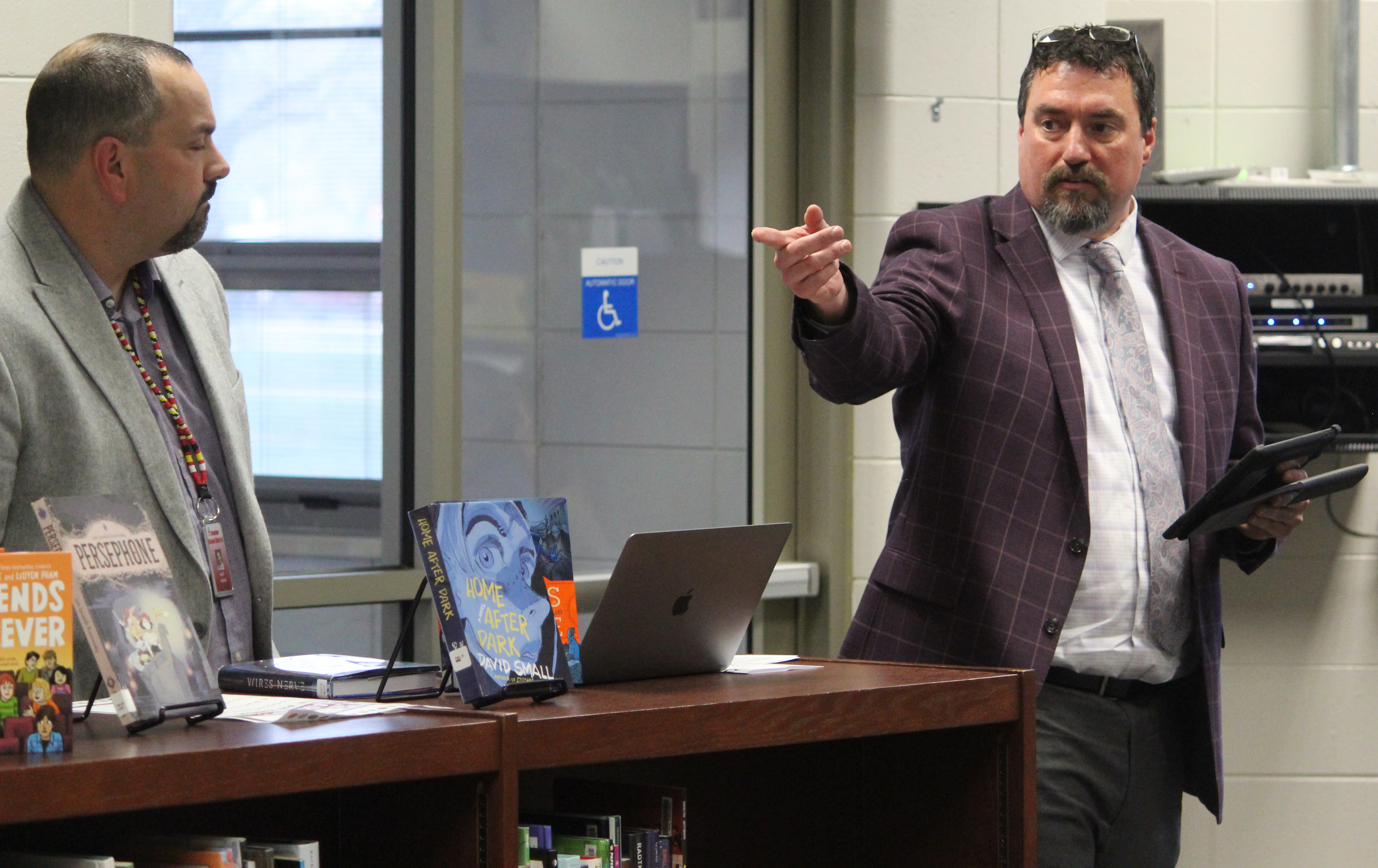
A proposal to equip two classrooms at Shawano Community Middle School with Smart Lab equipment to further enrich students’ learning options generated some discussion at the April 17 Shawano School Board meeting.
The setup for the two classrooms is expected to cost $235,000 initially, with an additional $7,000 annually to maintain, according to SCMS principal William Traber. The district first learned about the Smart Labs at a recent education convention and felt it would be a good use of the third round of Elementary and Secondary School Emergency Relief funds that schools have to spend soon.
The district has more than $3.4 million from the ESSER funding left to spend, and with the caveat that 20% of those funds, around $680,000, have to be spent on evidence-based curriculum items, administrators thought the Smart Labs would be a good investment.
“This is bringing 21st century learning strategies,” Traber said.
Both classrooms would be outfitted with items that target the subjects of science, technology, engineering and math (STEM). In one classroom, students would be learning about robots, wind experiments, bridge design and more. In the other, a studio would be created to allow for video production, where students could develop commercials; record video yearbooks; produce music albums, news segments and podcasts; and even film feature-length movies, all with the help of professional-grade equipment.
Traber said that the Smart Lab equipment would help achieve the district’s efforts to get students ready for college and careers, and it would do so in an earlier period of development, instead of students having to wait until high school to explore various technological and engineering careers.
“This is my way of getting a grassroots effort to bring those pathways down to the middle school, and so if they start working in the trades or they start working in automotive, they have some of the skills developed, and they have the opportunities at the middle school to start developing that logical way of thinking and those problem solving skills,” Traber said. “This will implement equity in education.”
Traber added that the Smart Labs would help to engage students and allow them to see themselves in their learning through hands-on projects, as opposed to lectures in a classroom and tests.
“When we have the students buy in when they come through those doors and they’re excited to go to class, then they feel like they’re a part of something,” Traber said.
Pat Salstrand, sales manager for Creative Learning Solutions, which oversees the Smart Labs, said the labs are turnkey, with learning kits stored in plastic bins for easy access. He noted that the labs are organized so students know immediately where to go to get materials for a specific project.
“We work with over 90 different vendors, whether it’s bringing in robotics or environmental science probes or working with Adobe and having kids doing animation,” Salstrand said. “What we don’t want teachers to do is have to say: ‘Oh, I’m going to do this activity, but I have 42 consumables I have to track down, and I have to find all these things to make this happen.’ We’re going to provide you with all the materials you will need for those students to be successful with those activities.”
Salstrand noted that many people, when they think of STEM, assume it’s limited to coding and robotics, but the Smart Labs go beyond that.
“Maybe when I get into coding, I think that maybe it’s not my cup of tea, but when I get into graphic design and animation and I’m coding there, I’m coding for a purpose,” Salstrand said. “It’s not going to be so much instructional as it is a house for all of their content that they’re creating. The majority of the time, when you walk into a Smart Lab, you know it’s a little bit more chaotic because there’s a lot of activity, but students are doing things. You’re never going to walk in, and it’s a quiet Smart Lab.”
Although most on the school board seemed intrigued by the proposal, board member Mart Grams did not see the value of spending so much money on the Smart Labs when the district is seeing reduced funding overall because the student population is shrinking. He suggested that the money would be better spent hiring teachers.
“Special projects get whatever they want,” Grams said. “This is cute. For $25, I would buy this for my granddaughter. None of that stuff is going to make them a citizen.”
The Smart Labs were presented for information only, and the board will vote on whether to purchase the materials at a later date.
lpulaski@newmedia-wi.com
Smart Labs eyed to enhance SCMS learning