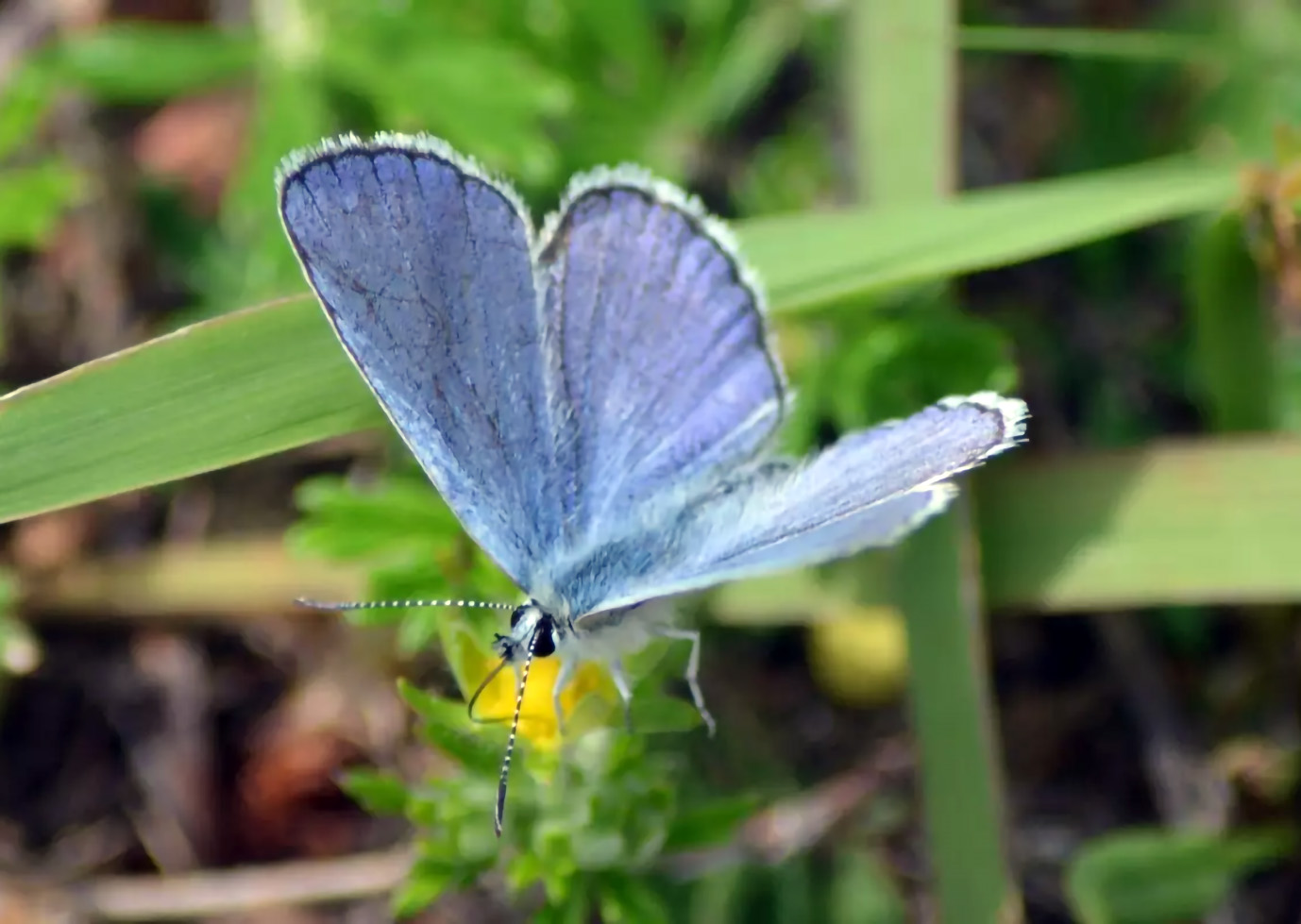
While I was out working in the yard yesterday, I saw a Karner blue butterfly. What a thrill. The last one I saw was in 2016 as I hiked near Glockie Lake, a challenging six-mile segment of the “Hundred Miles for a Hundred Years” Townsend Centennial Walk. I remember stopping to watch this remarkable creature hover and flutter its delicate one-inch powder blue wings right in front of me. I was so entranced I almost got hit by a passing pickup truck.
I saw three more Karner blues two days later on the next segment, seven even more remote and intimidating miles on Gluckie Lake Trail. Wow, I had never seen a Karner blue, and now four in one week. That was some kind of wonderful. I figured I would probably never see another in my lifetime. Sadly, butterfly populations are declining dramatically, and these blue beauties have been on the endangered species list since 1992.
The Karner blue’s scientific name is Lycaeides melissa samuelis. (I’m guessing the scientist who named it had a daughter named Melissa and a son named Samuel). Canada lists the Karner blue as extinct, but they can still be found in the Great Lakes states and small areas of New Jersey, New Hampshire and New York. Wisconsin’s Necedah National Wildlife Refuge is home to the world’s largest population due to the its vast area of savannah and extensive fields of lupine.
I said hello to my unexpected visitor, taking the time to enjoy the encounter with this rare, enchanting creature. I congratulated myself on planting wildflowers in my garden a few years ago. One of them was blue lupine, happily growing near a thriving stand of milkweed, the only weed given permission to freely grow in my garden. That’s because monarchs, another endangered species, cannot exist without milkweed, and I am doing what I can to help the monarch population rebound.
Now Karner blues won’t touch milkweed, but they cannot live without blue lupine, a lovely wildflower that blooms in late May. Blue lupine is the sole larval food source of the Karner blue. In one of those fascinating symbiotic relationships of the natural world, when Karner blue larvae feed on lupine leaves, the resulting damage actually helps the plant to thrive.
Monarch butterflies can have several generations each year, but Karner blues have just two. The first flight occurs sometime between mid-May and mid-June. First flight females lay their eggs on the lupine; then the eggs develop into the adults of the second flight, which generally occurs in July and August. It’s a marvelous stroke of luck I even saw a Karner in my yard, probably because the weather didn’t warm up this year until late May.
I’m fairly confident that all the Karner butterflies I saw were adult males. Not only do the male and female butterflies differ in appearance, adult males like sunny open areas whereas juveniles and females prefer shade. When I saw the butterflies in 2016, they were on a sunlit gravel road winding through an open area covered with wildflowers. The one yesterday was near my flower bed, an open area baking in the sun during our drought-like conditions.
When you have a very limited lifespan, you need to get your priorities straight. These butterflies spend their three to five days of life gorging at their own version of an all-you-can-eat buffet. During one Necedah study, adult Karner blues were observed feeding on the nectar of over 40 different flowering plants.
When they’re not eating, they’re mating. Once that mission is accomplished, the males go back to their outdoor feasting and leave the females to the hard work of producing the next generation. I mentioned that to my husband, Jon. “That sounds like a helluva life if a guy could expand it to say, 90 years.” I smiled sweetly and reminded him it was his turn to make dinner.
I know it doesn’t seem possible, but Karner blues and I have a lot in common. We both love wildflowers. We hate hot, humid weather and thrive when the thermometer reads 75-80 degrees. We love blackberries, except they like the flowers while I like the fruit. We hate wasps, flies, spiders and other biting insects. One major difference: they hate dragonflies and white tail deer; I love both. Then, dragonflies wouldn’t devour my young and deer wouldn’t consume my children’s sole source of food.
Still, all in all, doesn’t living like a Karner blue sound like fun? After all, humans also enjoy feasting and mating. I decided to put the question to Jon. He pondered it for a moment and then suggested we go out to dinner and come home to snuggle. Like the Karner blue, the man definitely has his priorities straight.
Kathleen Marsh is a lifelong educator, writer, and community advocate. She has published eight books, four on the history of Townsend, where she and husband Jon are happily retired on the beautiful Townsend Flowage.
Oh, to live like a Karner blue butterfly