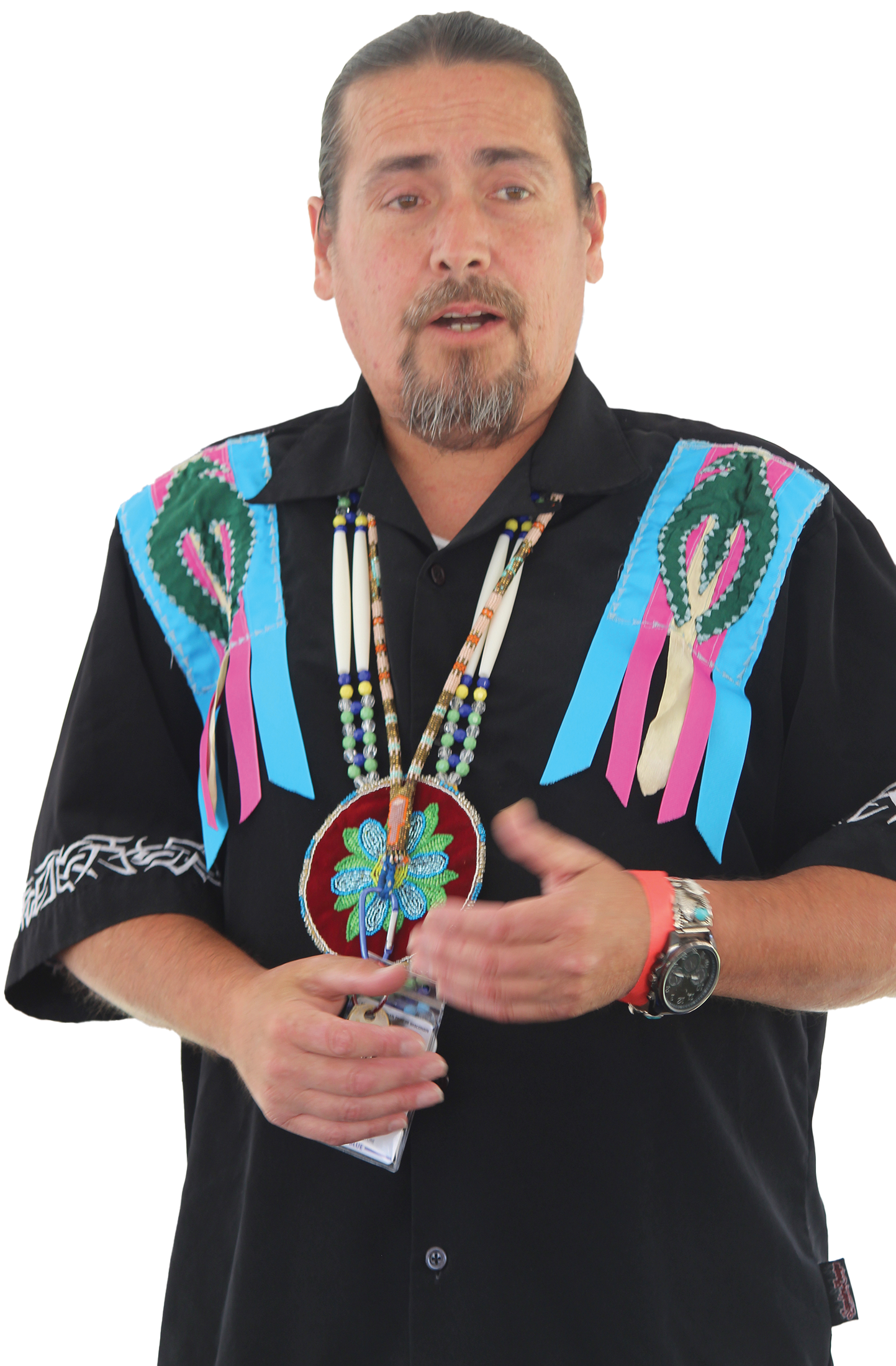
For Joey Awonohopay, storytelling is in his blood.
Awonohopay, who serves his Menominee community as a tribal legislator and director of language and culture, continues a tradition going back generations when he tells the stories of his people, whether it’s to his grandchildren or on a larger stage to fellow tribal members and visitors. Alternating seamlessly between his ancestral language and English, Awonohopay captivates audiences with the stories that have been passed down by tribal members for generations.
Many of the Menominee stories tell about the origin of the people, according to Awonohopay, when the world was still being made.
“A lot of the teachings we want instilled in our children are told through the stories,” he said.
Stories are more traditionally told during the winter months in the Menominee culture. Awonohopay said a limited number of stories can be shared during warmer weather, but it’s believed that once the ground freezes, that’s the time to instill knowledge in the younger generations of Menominee.
“Once that beautiful white blanket is laid across the land, that is the time when we can tell the stories about the animals,” Awonohopay said. “We can talk about the birds, and we can tell the stories about the fish. A lot of our winter stories revolve around why animals are the way they are, why they look the way they look, why they eat the things they eat.”
Awonohopay noted it’s important to tell the stories the way that the Menominee ancestors told them “to keep the authenticity of the story.” He noted the tribe is fortunate in that the stories have been documented and recorded in order to keep them from changing as future generations remember the stories differently.
“They did a lot of documentation,” Awonohopay said. “Back then, it was the old wax cylinders. Then it turned into the reel-to-reel. Then it was the cassettes. Now, of course, it’s the CDs and the electronic downloads and today the livestreaming.
“We’ve been very fortunate that our elders have documented in their own writing of a lot of their family stories that are passed down from generation to generation,” Awonohopay said. “We’re very fortunate that storytelling in our tribe has been a huge piece of our identity and our upbringing for our children.”
The storytelling tradition is strong in the Awonohopay. His great-grandfather, John Awonohopay, served as one of the last orators for the Menominee tribe, but his grandfather, Johnson Awonohopay, also had a reputation for being a storyteller as a chief for the tribe.
“Next would be my uncle, Richard Awonohopay,” Joey Awonohopay said. “He was well known for being involved with language, culture, traditions, storytelling. Now in my generation, that responsibility lands on my shoulders to continue telling those stories.”
Awonohopay noted his family was one of the few who lived outside the central hub of Keshena, setting down roots in Zoar on the western edge of the Menominee Reservation. He noted the community is at the settlement where the rivers fork.
“Being so secluded and so far away from the central hub of Keshena, our elders and our ancestors were able to continue the language and the culture, the traditions, the ceremony, the spirituality, and of course, the stories,” Awonohopay said. “Even when I was a child, they still gathered us in the various houses in winter, and the stories would be told to us.”
Awonohopay enjoys being able to share Menominee stories outside the fold whenever visitors show up or whenever he travels to other places. He noted that, even though the tribes all have stories on animals, tradition, medicine and so on, the stories differ from nation to nation.
“Stories are unique to every tribe, and even though we may share similarities with our Ojibwe relatives, we may share similarities with the Potawatomi tribe, there’s definitely uniqueness to each of us as a nation and as a people,” Awonohopay said. “For me, it’s sharing a little piece of who we are as the people of this land. We’re some of the original inhabitants of Michigan and Minnesota and so our roots have always been here.”
Because the Menominee have never migrated, many of the stories are connected to the Wolf River, the Menominee River, and on down to Oshkosh and Chicago.
“It helps people understand that when we say we’re original inhabitants, it gives specific credibility on a spiritual aspect,” Awonohopay said. “It gives people a better idea of who we are as a woodland people, as an Indigenous people, and it gives people a better idea of why we wear the attire we wear, the colors we wear, the floral patterns we wear.”
Awonohopay described storytelling as being more than just reciting tales.
“Being a storyteller, it’s almost like being an actor,” Awonohopay said. “You have to be able to step out of your comfort zone, because you’re always trying to captivate your audience. You’re trying to make them feel, real time, the emotions in the story, so when there are sad points, you want to make people feel that with your voice and through your expressions. When there’s happy points and excitement in a story, you have to be able to work on that tonation to hit the high points.”
lpulaski@newmedia-wi.com
Telling tales a tribal tradition