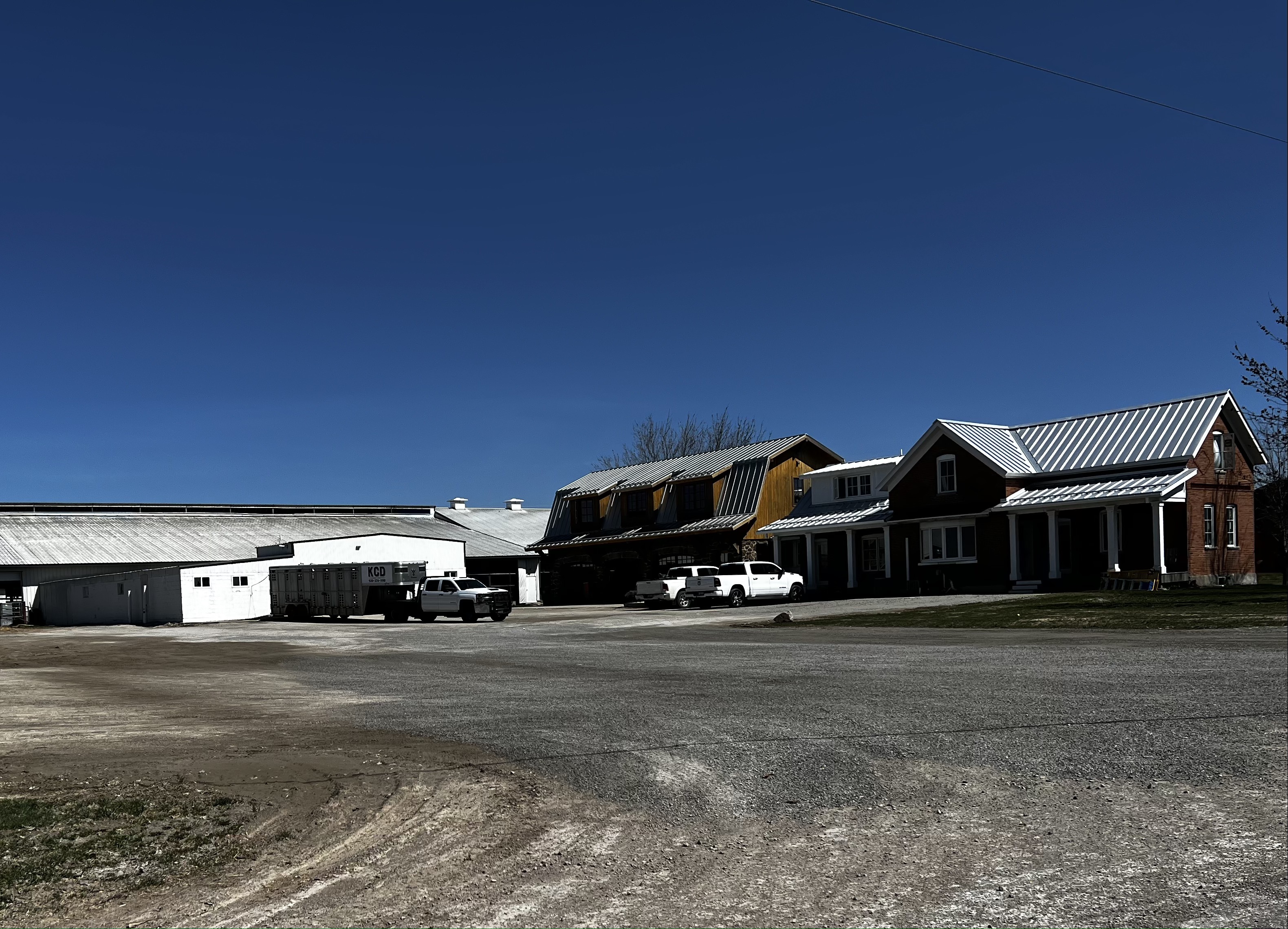
The Shawano County Land Conservation Department hosted a public informational meeting on April 13 regarding the expansion of a farm in Pulaski.
Owned by Jeff Betley, Betley Farms, W1630 Redwood Drive and W2227 Cedar Drive, Pulaski, is looking to double its herd from 3,894 animal units to 8,117 animal units. An animal unit is a measurement of how an animal influences a farm through food and waste. A larger animal, like a fully grown cow, usually has an animal unit that is larger than one.
Shawano County Conservationist Scott Frank kicked off the meeting by explaining that this meeting is scheduled to hear public input on the proposed farm expansion. For those who attended the meeting on April 13 and for those who didn’t, but still want to voice their opinion, Frank said that the county is accepting comments and questions through April 24.
“This meeting is being conducted to provide an explanation of the application for expanded live stock facilities and to receive public input on the application,” said Frank.
Frank added that the land conservation department has a 90-day window to make a decision on the proposal, something that he said probably won’t take all 90 days.
Betley said that he has and his wife have two children in college who are interested in coming back to the area to run the farm.
“This is really about setting up the next generation,” said Betley. “This process started two years ago with a thought on how we could handle waste better.”
He explained that Betley Farms is looking to change some things around their farm in order to continue a digesting process on the farm. A digesting process on a farm involves breaking down organic materials, like manure, in order to treat waste and reduce odor.
“All of the stuff being built now is to take that methane, make it into pipeline-grade renewable natural gas and then push it into the system,” said Betley. “The digester has more room for cows if need be, but we can do what we are doing, or we can add cows. It really depends on the next generation for us. We will make sure that they are set up to succeed as much as we can.”
North Coast Power Systems Vice President of Engineering Darrin Shersted said the digesting process further, saying that this upgrade will be beneficial to the farm.
“The manure would go into the digesters and emit bio-gasses — it is pretty dirty and has some impurities in it, so that would be upgraded on the farm,” said Shersted. “In terms of pipeline quality, it would be the same stuff — identical to natural gas coming out of Texas or Oklahoma.”
Betley added that the odor is what the farm is looking at eliminating.
“Anytime you are on a dairy farm and you smell manure, that is gas that could have been collected,” said Shersted. “It is in Jeff’s ultimate interest to have as minimal smell as possible, because that means every molecule of gas that could have been made on the farm is being collected.”
Shersted said that there are plans to put in a small treatment facility to turn some of the manure into clean water.
“That could be reused on the farm or discharged to a stream,” said Shersted.
He went on to explain that in the proposal next to the three existing barns at the Redwood Drive location, a fourth and fifth barn would be included on the farm. Also in the proposal, Betley walked through a proposed barn at the Cedar Drive location.
“One of our pet projects is high-end genetics,” said Betley. “We have to figure out not to be a commodity producer. We do raise high-end genetics for two bull-studs and part of our proposal, if we put that barn up would be to do a lot of embryo work and embryo transfers. There is some opportunity to making some money helping the industry with the genetic process. It is more of a lab with cattle housing.”
In regards to the odor score, Shersted said the farm’s odor score comes out to 763. The Wisconsin state law dictates that a score of 500 or more is passing.
“Anaerobic digestion would be a controlled practice, now the diet manipulation is a controlled practice to reduce odor,” said Shersted. “(Diet manipulation) would just be a more specific look of what you are feeding your cows. Everything that you are putting into your cows is extremely well thought out, calculated and is an exact match of what you need to take care of the cows for milk production.”
lreimer@newmedia-wi.com
Betley Farms seeks to double animal units